Correction, 12 October 2026: on 10 October 2026 BestFolio's GPM moved to Keuning and Keller's published rules (12 risky assets, crash protection that rises in equal steps as breadth fails and sits in IEF or short Treasuries). Its card now shows 9.65% CAGR and a 1.17 Sharpe; the GPM figures below (9.2% and 1.13) are the release figures under the earlier rule.
Correction, 13 October 2026: the synthetic history of GDE before its March 2022 launch now matches the fund's 90/90 exposure (90% S&P 500 and 90% gold futures), so TQQQ Quadrant Stack's card was rerun: it now shows an 18.5% CAGR (was 18.6%) with the same 0.91 Sharpe, and the text and table below say so. The chart keeps the release figures.
Five strategies go live on August 25, bringing the public catalog to 93 published strategies, 72 of them tactical. All five are Pro; the free tier is unchanged. The batch also ships a leveraged variant with the strongest risk label we have put on any strategy page. One thread connects these releases: inflation-regime rotation was the scenario the catalog handled least well, and this batch addresses that directly.
Inflation Compass
David Varadi's Inflation Compass leads the batch, and it is the cleanest mechanism I have seen for inflation-regime rotation: one sector position at a time, refreshed monthly, determined by two independent regime reads. The growth signal comes from SPY's 200-day moving average. The inflation signal uses the bond market's 5-year breakeven rate, confirmed by a sector ratio, so it reflects what the market is currently pricing rather than what last month's CPI report said.
Each of the four quadrants maps to a specific sector, and the strategy holds only that sector for the month. The card runs on data back to 1950 and its backtest now starts in January 1950, covering every postwar inflation episode. Because live ETFs did not exist for most of that period, the deep-history portion runs on index and mutual-fund proxy chains, as it does for all long-window strategies in the catalog. The result across that full window is 17.3% CAGR with a Sharpe ratio of 0.98.
Inflation Compass succeeds Growth-Inflation Sector Timing in the catalog; that strategy stays published with a cross-link between the two pages.
TQQQ Quadrant Stack
TQQQ Quadrant Stack is the first strategy in the catalog credited to a Reddit username. It was designed by u/Separate-Ad-9633 in r/LETFs, and the card carries that attribution. The structure pairs a 30% TQQQ sleeve with ZROZ, international small-cap value, and return-stacked diversifiers. SPY and TLT trend breaks each gate their respective sleeve, routing into gold and managed futures when conditions deteriorate. Half the book (the diversifier side) never trades. The card result is 18.5% CAGR with a Sharpe of 0.91.
It loses money to monthly whipsaw. In years where both trend signals change direction frequently within short windows, the strategy takes losses from multiple sides at once. The clearest examples in the backtest are 2018 and 2022. That cost is visible in the detailed results and worth understanding before sizing the strategy in a live portfolio.
Three Classics for the Core
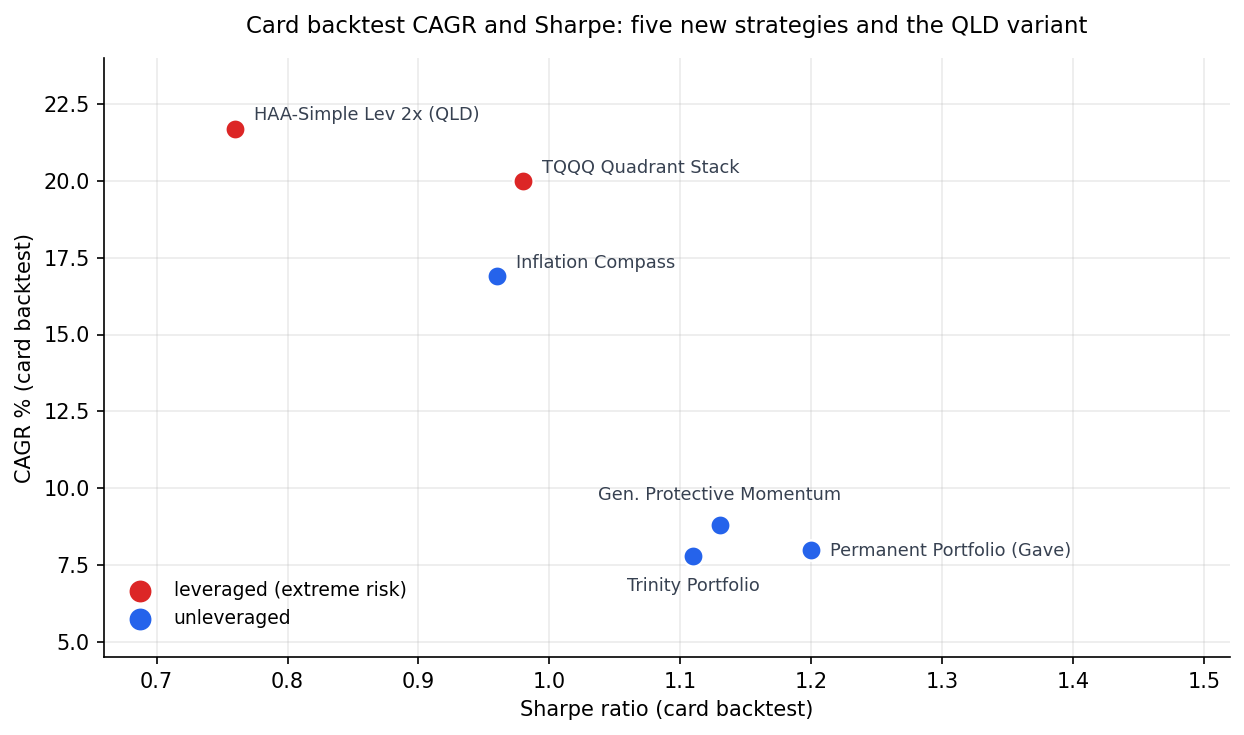
Three well-established strategies round out the batch as ballast and blend material rather than return engines. GPM (Generalized Protective Momentum, by Keller and Keuning) delivers 9.2% CAGR with a Sharpe of 1.13. BestFolio's Three-Asset Trend (VTI/VEU/AGG), released as Meb Faber's Trinity Portfolio, runs at 7.7% CAGR with a Sharpe of 1.06. It is our own model, inspired by Faber's trend work: VTI, VEU and AGG in thirds, each held only above its 200-day average. Faber's Trinity keeps half in buy-and-hold, so we renamed it on 13 October 2026. Charles Gave's Permanent Portfolio (Gave) posts 7.9% CAGR and the highest Sharpe of the three at 1.17. These are not return maximizers. Their value lies in what they do not cost during periods when higher-octane strategies draw down hard.
HAA-Simple Leveraged 2x (QLD)
HAA-Simple Leveraged 2x (QLD) ships as a variant of HAA, added by subscriber request. The performance history is notable: 23.5% CAGR and a Sharpe of 0.81 across the full backtest window. The risk history must be read alongside it.
The dot-com unwind produced a drawdown of roughly -83% on daily prices, and the strategy took 9.9 years to recover. A second deep episode runs from 1983 into early 1988. These are not theoretical tail risks; they represent what the strategy has actually done under severe stress. The history is brutal, and I would rather lose a signup than hide it. The strategy page flags this as extreme risk and states plainly that it is not investable on its own. It belongs only inside a broader portfolio where a volatile position can be properly sized and where a holder has genuinely thought through what staying underwater for that long means in practice.
Live for the September Rebalance
All five strategies, plus the QLD variant, are live today with full backtests and current signals, in time for the September rebalance. Signals publish on the first trading day of September. All are Pro.
The full release:
| Strategy | CAGR | Sharpe |
|---|---|---|
| Inflation Compass | 17.3% | 0.98 |
| TQQQ Quadrant Stack | 18.5% | 0.91 |
| GPM | 9.2% | 1.13 |
| Three-Asset Trend (VTI/VEU/AGG) | 7.7% | 1.06 |
| Permanent Portfolio (Gave) | 7.9% | 1.17 |
| HAA (QLD variant) | 23.5% | 0.81 |
Note (15 October 2026): the managed-futures history before KMLM and DBMF launched now uses the BTOP50 index, so TQQQ Quadrant Stack's card was rerun and now shows a 19.0% CAGR and a 0.93 Sharpe. The text and table keep the 13 October figures; the strategy pages carry the current ones.
Note (17 October 2026): every card was rerun with longer warm-up histories, so most of these backtests now start earlier. The cards now show TQQQ Quadrant Stack at 19.9% CAGR from January 1996, GPM at 10.6% from January 1985, Three-Asset Trend at 8.5% and Permanent Portfolio (Gave) at 8.7%, both from January 1985, and Inflation Compass at 17.2% from January 1950. The text and table keep the release figures.
Past performance does not guarantee future results. Backtested results are hypothetical and do not represent actual trading.
Note (13 November 2026): every card was rerun on 9 November 2026 after several data fixes, and since 18 October Sharpe is measured above cash, so the table's Sharpe column and the 17 October note are on the earlier basis. The cards now show Inflation Compass at 17.19% a year with a 0.74 Sharpe, TQQQ Quadrant Stack at 19.32% and 0.84, GPM at 10.45% and 0.87, Three-Asset Trend at 8.41% and 0.69, and Permanent Portfolio (Gave) at 8.59% and 0.77. The text and table keep the release figures.