Meb Faber's Trinity Portfolio and Charles Gave's Permanent Portfolio update end up with similar long-run volatility, but they make very different decisions. Trinity asks whether 3 broad risk sleeves are each healthy enough to hold. PP Gave keeps stocks and bills permanently, then uses a gold-versus-bond signal for the final 1/3.
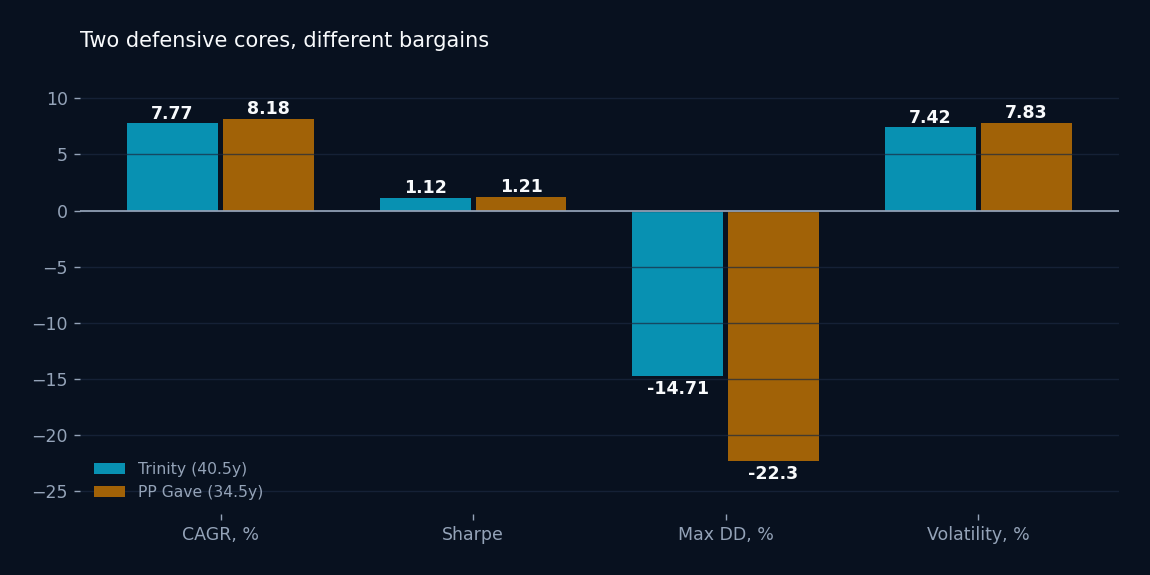
The current BestFolio cards make the similarity easy to see. Trinity reports 7.77% annualized return, a 1.12 Sharpe ratio, 7.42% volatility, and a -14.71% maximum drawdown over 40.5 years. PP Gave reports 8.18%, a 1.21 Sharpe, 7.83% volatility, and a -22.30% maximum drawdown over 34.5 years.
| Trinity | Permanent Portfolio (Gave) | |
|---|---|---|
| History | Feb 1986, 40.5 years | Feb 1992, 34.5 years |
| CAGR | 7.77% | 8.18% |
| Sharpe | 1.12 | 1.21 |
| Volatility | 7.42% | 7.83% |
| Max drawdown | -14.71% | -22.30% |
The annualized returns and volatility are close. The worst drawdown is not. The rules explain why.
Trinity: 3 independent trend decisions
Trinity divides the portfolio equally among US equities, international equities, and aggregate bonds. Each sleeve is compared with its own 200-day moving average at the monthly rebalance. A sleeve above trend is held. A sleeve below trend moves to Treasury bills.
The portfolio can therefore hold all 3 risk assets, any pair, only 1, or 100% bills. There is no ranking between US and international stocks. There is no macro forecast. Each 1/3 answers the same question independently.
That structure can cut exposure when several markets weaken together. It can also create repeated small exits when prices hover near their moving averages. Trinity buys its lower historical drawdown by accepting the timing risk of 3 separate trend rules.
PP Gave: keep 2 thirds fixed
PP Gave starts with 1/3 in US equities and 1/3 in Treasury bills. Those 2 allocations do not change. The final 1/3 goes to gold or intermediate Treasuries.
The switching signal is the ratio of gold to intermediate Treasuries compared with its 84-month moving average. When gold is strong relative to bonds, the final 1/3 holds gold. Otherwise it holds intermediate Treasuries.
This is a relative decision, not a trend filter on the whole portfolio. Stocks can be falling and still remain at 1/3. Bills stay at 1/3 even in a strong bull market. The only question is which defensive asset gets the final allocation.
Why the drawdowns differ
Trinity can move every risky sleeve to bills. PP Gave cannot remove its fixed equity 1/3. That does not make Trinity automatically superior, because every extra switch is another opportunity for a false exit and an expensive re-entry. It does explain why PP Gave can carry a deeper historical drawdown despite similar volatility.
PP Gave's structure is also less dependent on absolute price trends. The gold-bond ratio can prefer gold even when both assets are falling, as long as gold is falling less. That is useful when the investor wants a permanent allocation with a defensive tilt rather than a portfolio that repeatedly steps out of risk.
Implementation from Europe
A European investor should reproduce the exposure and the signal, not copy the US ticker symbols. Trinity needs broad US equity, developed international equity, aggregate bonds, and a Treasury-bill substitute. PP Gave needs US equity, short Treasury bills, physical gold exposure, and intermediate US Treasuries.
The important distinction is whether the substitute changes the signal asset. A UCITS fund can implement the allocation while the canonical signal remains tied to the original market series. If the investor changes both the holding and the signal, the result is a new strategy and should be backtested as one.
Currency also remains part of the allocation. A euro-denominated trading line does not turn underlying US equities or US Treasuries into euro assets. The listing currency and the economic currency exposure are separate facts.
Which core fits which problem?
Trinity is the cleaner choice when the investor wants each risk sleeve to justify its place every month and is willing to accept more switches. PP Gave is the cleaner choice when the investor wants a permanent equity and cash base, then a single relative rule for the last 1/3.
The cards do not identify a universal winner. Trinity had the smaller worst drawdown in these reconstructions. PP Gave had the higher annualized return and Sharpe ratio. The histories also differ, so the headline metrics are not a controlled comparison.
The useful comparison is the decision rule. 3 absolute gates or 1 relative gold-bond gate? A portfolio that can become fully defensive or one that always keeps stocks and bills? Once that choice is explicit, the similar volatility numbers stop hiding the difference.
Explore Trinity Portfolio and Permanent Portfolio (Gave).
Past performance does not guarantee future results. Backtested results are hypothetical and do not represent actual trading.