Cash looks like the easiest line in a tactical backtest. Give it 0%, use a T-bill series, or drop in BIL. The choice seems too small to change the story.
It changed CAGR by 0.87 percentage points in one fixed momentum rule. Almost all of that gap came from what cash earned while held. The signal itself barely moved.
Cash has 2 jobs
A monthly absolute-momentum rule can use cash as a hurdle. SPY stays risk-on only when its trailing 12-month return beats the cash series. The portfolio then needs a return for the months spent out of equities.
Those jobs can use different data. A researcher may compare SPY with a 3-month Treasury bill yield, then assign 0% to cash holdings. Another backtest may use BIL for both. Mixing the 2 choices inside one ticker column makes the source of the result hard to see.
We built a 3 by 3 matrix. The signal hurdle used a flat 0% NAV, a long T-bill proxy, or a NAV compounded from the Federal Funds rate. The held cash leg independently used the same 3 options. SPY went risk-on when its 12-month total return beat the chosen signal series, and the allocation changed the following month. Each switch paid 10bp.
The long-history matrix
Window: January 1994 through June 2026, 32.4 years, monthly signals, 10bp per switch. All 9 combinations produced exactly 17 switches, so the differences below are purely what the cash legs earned and demanded, not trading luck.
| Signal hurdle | Held cash return | CAGR | Switches |
|---|---|---|---|
| 0% | 0% | 10.93% | 17 |
| 0% | T-bill proxy | 11.44% | 17 |
| 0% | Federal Funds | 11.33% | 17 |
| T-bill proxy | 0% | 10.61% | 17 |
| T-bill proxy | T-bill proxy | 11.18% | 17 |
| T-bill proxy | Federal Funds | 11.06% | 17 |
| Federal Funds | 0% | 10.57% | 17 |
| Federal Funds | T-bill proxy | 11.10% | 17 |
| Federal Funds | Federal Funds | 10.98% | 17 |
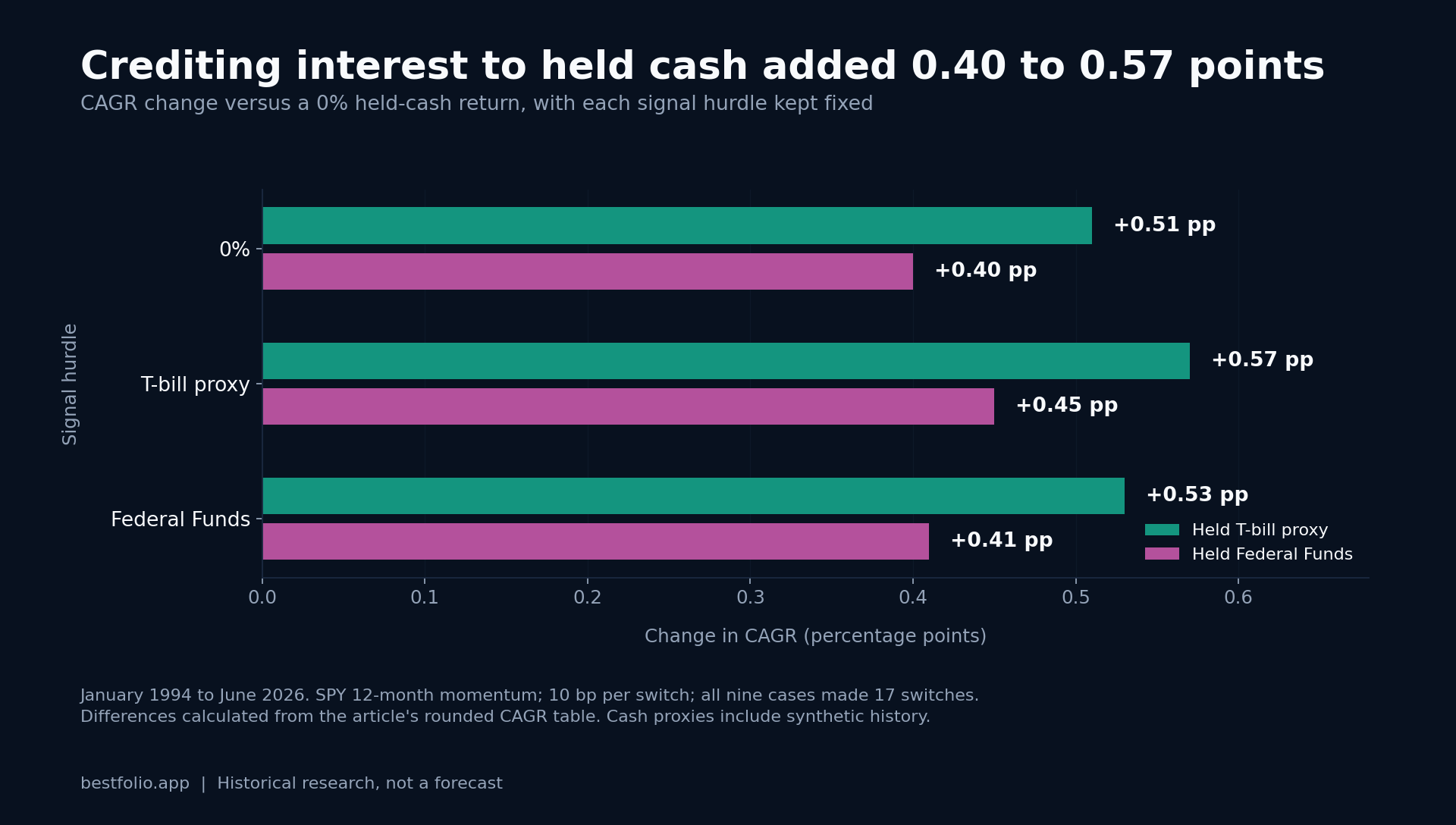
The highest cell used a 0% signal hurdle and paid the T-bill proxy while defensive. The lowest used the Federal Funds hurdle and paid 0% while defensive. Their CAGR gap, and the full 9-cell range, was 0.87 points.
Every combination switched 17 times. Cash yields changed a few borderline monthly comparisons without changing the total count. The larger effect came from the return credited during defensive months, especially when short rates were high.
Why a flat line causes trouble
A 0% cash return is conservative for the portfolio leg when bills earn interest. It is aggressive for the signal hurdle during high-rate periods, because equities only need to beat zero rather than the available risk-free return.
Using 0% for both can push in opposite directions. The gate stays risk-on more easily, then the defensive allocation earns too little when it finally exits. A single "conservative cash assumption" label misses that split.
Federal Funds creates another mismatch. It is an overnight policy rate, while an investor holds a fund, deposit or bill with its own expense, spread and settlement. A synthetic NAV compounded directly from DFF can overstate the cash an investor receives.
BIL solves one problem and creates another
BIL gives an investable total-return series with real fund costs. Its live history begins in 2007. Dropping it into a 30-year test either shortens the study or requires a pre-inception proxy.
Our long-history T-bill series uses the same documented fallback chain as the BestFolio engine. The live-BIL comparison starts at its own history and sits in the research table, kept separate from the proxy era. That separation matters whenever 2 strategies differ by a few tenths of a point.
A better reporting rule
Every tactical study should name 2 cash choices: the series used by the signal and the series used for portfolio returns. It should also mark the first live date and the proxy period.
This matters directly for GEM, which compares equity momentum with T-bills, and for HAA, which can hold BIL as a defensive asset. A leaderboard can change order when cash assumptions differ across rows.
The 0.87-point range in this test will look small beside an equity crash. Compounded for 32 years, it is large enough to choose a winner.
Related: Dual Momentum's 2022 Problem.