Covered-call ETFs come up in almost every portfolio thread I read now. A common one: someone in their early 30s opens a Roth IRA and puts most of it in QQQI and BTCI, or JEPI and JEPQ, because the monthly payout feels like progress. I get the appeal. Cash lands in the account every month, while price gains just sit on a screen.
In a Roth that reinvests every payout, though, the payout isn't extra money. It's part of the return, handed back and bought back. So I'd compare what the fund returns in total, payouts reinvested, with the plain fund it sells options on, on the same days.
Where the monthly cash comes from
A covered-call fund holds stocks (or bitcoin funds) and sells call options on them. Selling a call means someone pays you now for the gains above a set price. If the market goes sideways, you keep that premium and come out ahead. If it rips, those gains belong to whoever bought the call.
The payout also comes out of the fund. On each ex-date the share price drops by the amount paid. Reinvest it and nothing is lost. Spend it and your share count stays the same while the price is lower. Total return puts price and payouts back together, and it's the number to compare when you reinvest.
JEPQ and QQQI against QQQ, same days
QQQI started trading on 30 January 2024, so that's my start date for all 3. Payouts reinvested, to 9 October 2026:
| Same days, Jan 2024 to Oct 2026 | QQQ | QQQI | JEPQ |
|---|---|---|---|
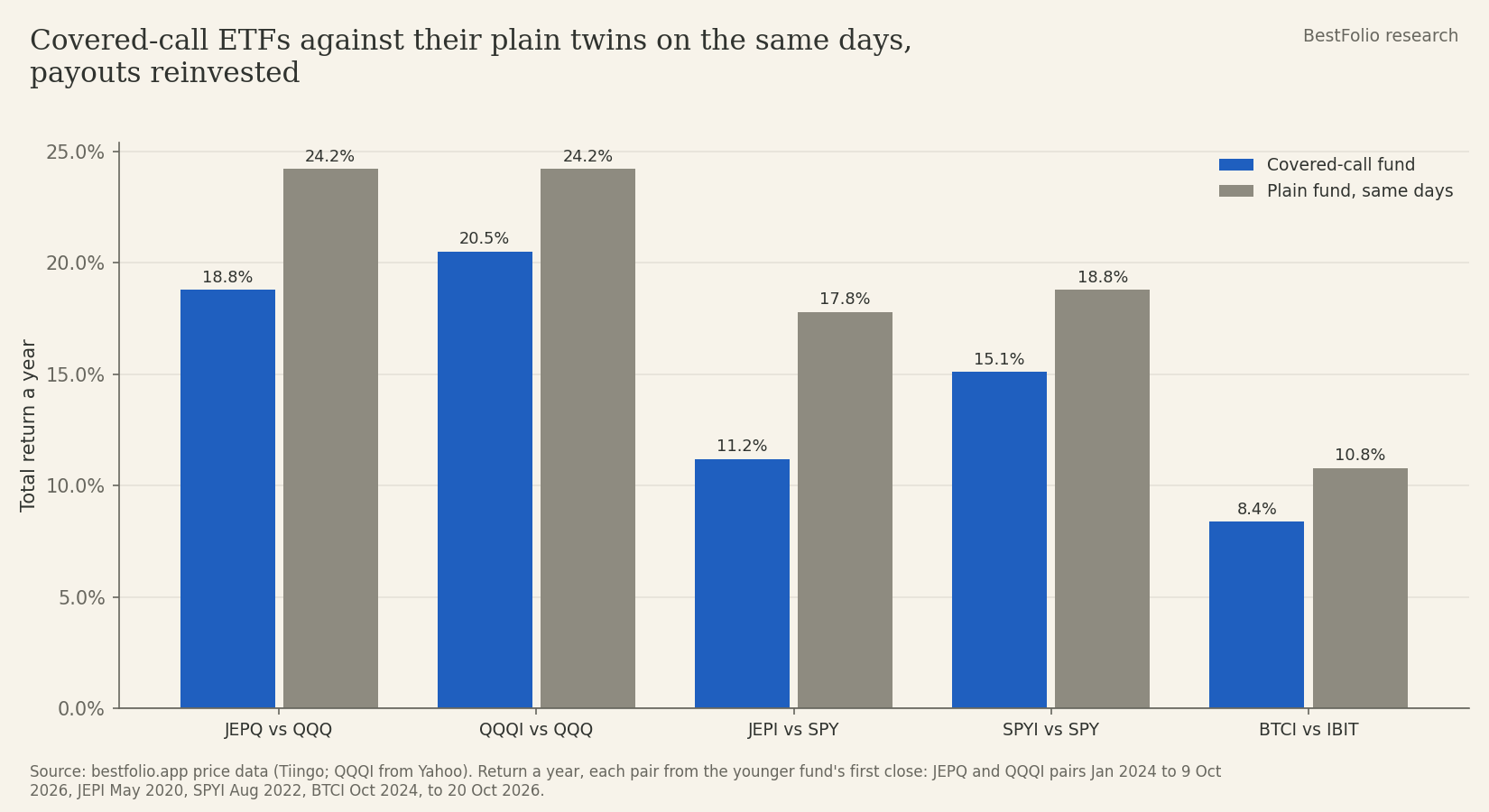
| Total return a year, payouts reinvested | 24.2% | 20.5% | 18.8% |
| $10,000 became, payouts reinvested | $17,900 | $16,510 | $15,887 |
| Share price change alone | +76.6% | +12.9% | +17.6% |
| Cash paid out per $10,000 at the start | about $190 | about $4,000 | about $3,200 |
| Fall from 19 Feb to 8 Apr 2025 | -22.8% | -20.0% | -20.1% |
| Rebound from 8 Apr 2025 to 9 Oct 2026 | +81.6% | +63.9% | +58.3% |
Over the last 12 months of that window JEPQ paid about 11% of its share price and QQQI about 14%. The last 2 rows hold the whole trade. In the selloff the options saved about 3 points. In the rebound they cost 18 to 23 points, because the calls had already sold most of the bounce. QQQ and QQQI were back at their February high on the same day, 24 June 2025, and JEPQ only on 8 August.
QQQI's share price is up 12.9% in 2.7 years. Most of what it earned came out as cash, and if you reinvested all of it you ended about $1,400 behind plain QQQ per $10,000. JEPQ ended about $2,000 behind. It's a short window with 1 real selloff, so I wouldn't read much into QQQI against JEPQ yet.
Same pattern on other underlyings
I ran the same test on 3 more funds, each from its first close to 20 October 2026, against the plain fund it writes options on.
| Pair, from the fund's first close to 20 Oct 2026 | Fund, return a year | Plain fund, return a year | Fund's payout, last 12 months, % of price | Fund's worst fall | Plain fund's worst fall |
|---|---|---|---|---|---|
| JEPI vs SPY, from May 2020 | 11.2% | 17.8% | 8.0% | -13.7% | -24.5% |
| SPYI vs SPY, from Aug 2022 | 15.1% | 18.8% | 11.9% | -16.5% | -18.8% |
| BTCI vs IBIT, from Oct 2024 | 8.4% | 10.8% | 31.1% | -48.4% | -53.3% |
Every one of them gave up return and every one fell less in its worst stretch. JEPI shows it most clearly: a much smaller worst fall, -13.7% against -24.5%, and 6.6 points a year less return over 6.4 years. On $10,000 that's $19,767 against $28,525.
BTCI shows the other thing a big payout can hide. Over the last 12 months it paid out about 31% of its price, and its total return over the same 12 months was -24.5%. Both are true. Bitcoin fell (IBIT -25.8%), and the payout came out of a shrinking fund. A large cheque can arrive while the account goes down.
Similar label, very different bets
| Fund | What it holds | How it earns option income | Expense ratio, % a year |
|---|---|---|---|
| QQQI | Nasdaq-100 stocks | Sells Nasdaq-100 index calls, buys some back | 0.68% |
| JEPQ | Actively picked Nasdaq-100 stocks | Option premium plus stock dividends | 0.35% |
| JEPI | Actively picked S&P 500 stocks | Option premium plus stock dividends | 0.35% |
| SPYI | S&P 500 stocks | Sells S&P 500 index calls | 0.68% |
| BTCI | Bitcoin funds | Sells calls tied to bitcoin fund prices | 0.99% |
The monthly schedule is the only thing these 5 share. A Roth with QQQI and BTCI holds the Nasdaq-100 and bitcoin, 2 concentrated bets. The calls reshape each one, and the concentration stays.
Accumulating and spending are different jobs
In a Roth that reinvests everything, the account's job is compounding, so total return after fees is what counts. The Roth already shelters the payout from tax, so the usual argument about how option income is taxed doesn't apply here either.
Drawing cash in retirement changes things. A regular payout is convenient, and a smaller worst fall can make a portfolio easier to hold. That's a real use case when the cash actually gets spent. It doesn't remove sequence risk, though: a fund can keep paying while its price falls early in retirement. I'd compare any income plan against something simple like Classic 60/40, with withdrawals starting at bad dates, before trusting the payout.
4 checks before buying one
- Look through to what it holds. Nasdaq stocks, an active stock basket and bitcoin funds are different risks before any option is sold.
- Read the option policy. How much is covered, how far out the strike sits and whether it buys calls back decide how much upside is left.
- Decide where the cash goes. Spending it makes the payout useful. Reinvesting it turns it back into share price.
- Compare total return on the same days. Reinvest every payout, include the fee and use the plain fund the options are written on.
For the early-30s Roth
I'd start from the job: grow the account for 20 or 30 years and sit through normal stock market falls. A broad, cheap stock fund does that job with no help. A covered-call fund can sit beside it if you want the monthly cash or a calmer ride, and in every pair above it cost return to get one. If the payout keeps you saving, keep a slice for that, and judge it once a year on total return.
Figures from BestFolio's price data (Tiingo adjusted closes) to 9 October 2026 for the QQQ, QQQI and JEPQ table and to 20 October 2026 for the rest; QQQI prices from Yahoo, cross-checked on QQQ and JEPQ to 0.2 points. Payouts in the last 12 months are read from the gap between adjusted and raw closes on ex-dates. Expense ratios from the issuers on 21 October 2026 (NEOS) and the September 2026 fact sheets (J.P. Morgan). Short windows: QQQI, SPYI and BTCI have between 2 and 4.1 years of history. Nothing here is a recommendation to buy or sell any fund.
Related: We Extended Our Backtest to 1974: The 4% Rule Through Stagflation