Historical study: the results below are the June 2, 2026 snapshot, preserved to show what changed when the test history was extended to 1974. They have not been rerun for this graph update and are not current strategy-card values. The later CPI correction concerns pre-1947 coverage in different backtests.
A few weeks ago we posted a study here measuring the safe withdrawal rate for more than 50 tactical strategies, all run through the same Bengen rolling-window method. The most common and most fair pushback was some version of this: your data starts in 1990, so of course the numbers look generous, you skipped the decade that actually breaks retirement plans.
That criticism was correct, and it was the caveat we flagged hardest in the original post. So we spent the time to fix it. We extended the price history for the headline strategy, Hybrid Asset Allocation, back to February 1974, through the 1970s stagflation, the 1980-82 Volcker recessions, and every bear since. This is the follow-up, with the numbers re-run on 52 years instead of 35.
Here is the headline, stated against ourselves so there is no confusion: the safe withdrawal rate went down.
What changed when we added the 1970s
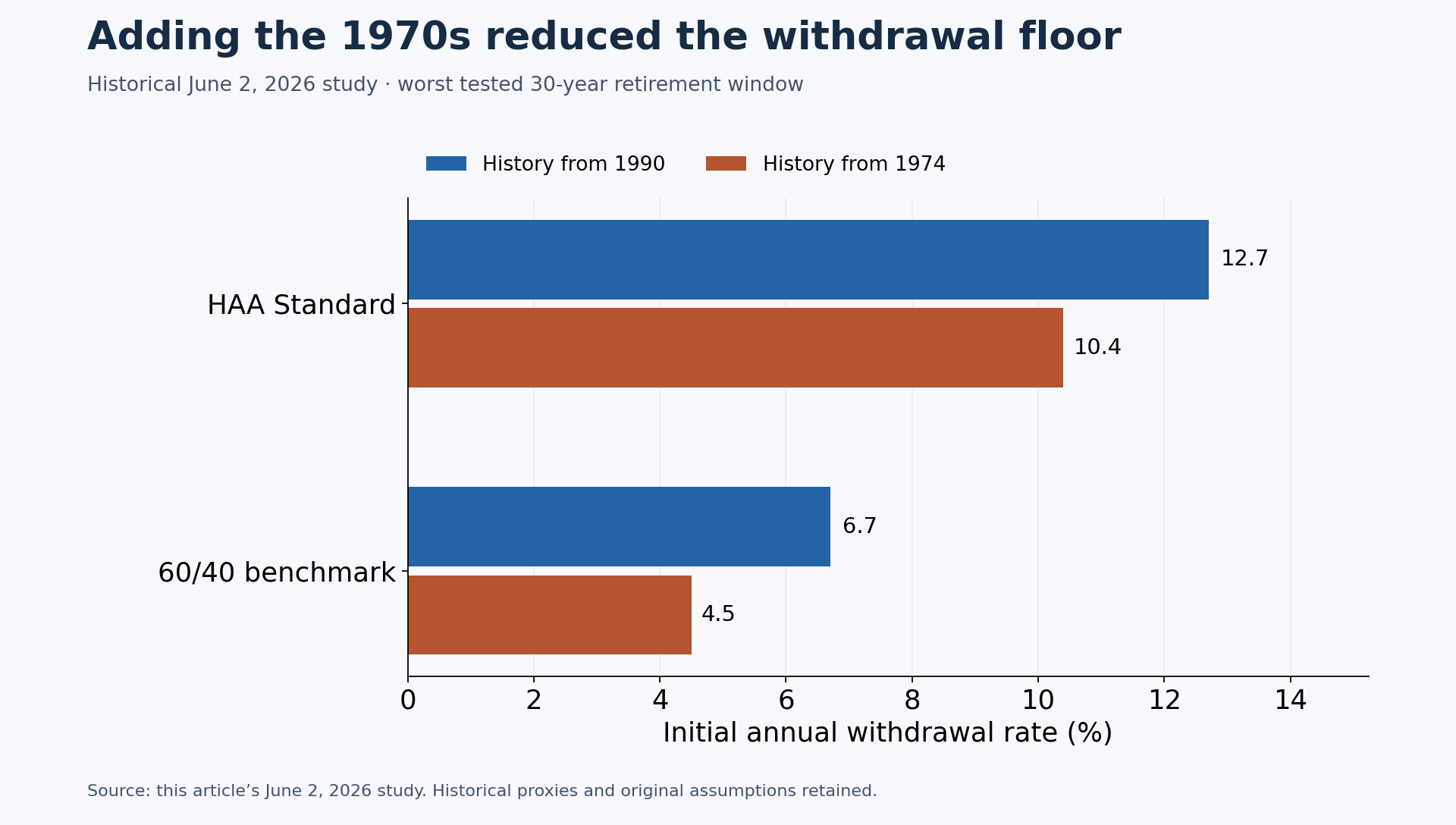
In the May study, on data from 1990, HAA's standard variant showed a 12.7% worst-case safe withdrawal rate. On the extended window back to 1974, that number is 10.4%. The 60/40 benchmark moved the same direction, from 6.7% down to 4.5%.
| Metric (HAA Standard) | 1990-2026 (May study) | 1974-2026 (extended) |
|---|---|---|
| CAGR | 14.3% | 16.3% |
| Max drawdown | -19.7% | -19.7% |
| Safe withdrawal rate (worst case) | 12.7% | 10.4% |
Three things are worth pulling out of that table.
The CAGR went up, from 14.3% to 16.3%, because the longer window picks up more strong years. The max drawdown did not move at all, because HAA's deepest loss in either window is still the 2000-02 dot-com decline at -19.7%. And the safe rate came down, from 12.7% to 10.4%, because the worst-case 30-year window is no longer a 1990s-start retiree. It is now someone who started drawing income in 1974, straight into double-digit inflation. That is the cohort the 4% rule was built to survive, and it is exactly the test the old window was missing.
A backtest that gets less flattering when you add harder history is a backtest you can trust a little more. If extending the data had pushed the number up, you should have been suspicious.
Why stagflation is the real test
Bill Bengen, who gave us the 4% rule in 1994, spent 2025 arguing it is too low. His updated work raises the worst-case safe rate to 4.7%, and in interview after interview he keeps returning to one point: inflation, more than any single market crash, is what threatens a retirement. A crash you can wait out. A decade of rising prices quietly raises the size of every withdrawal you take, for the rest of your life.
That is why a 1974 start matters. A retiree who began drawing income that year faced a market down sharply and a cost of living rising 6%, then 11%, then 13%. Their withdrawal had to climb with it. A portfolio losing value while its required withdrawal compounds at double digits is the precise scenario Bengen now calls the real danger, and until this month our backtest could not show how a tactical strategy handled it. Now it can.
The 52-year record
Here is HAA against three reference points over the full February 1974 to May 2026 window. The 60/40 is the classic mix. All Weather and the Permanent Portfolio are the two best-known all-seasons portfolios, included because they are the honest competition for anyone who already believes in diversification.
| Strategy | CAGR | Max drawdown | Calmar | Worst 5-year return |
|---|---|---|---|---|
| HAA | 16.29% | -19.7% | 0.83 | +15.2% |
| Classic 60/40 | 9.01% | -34.7% | 0.26 | -13.9% |
| All Weather | 7.73% | -22.5% | 0.34 | +12.4% |
| Permanent Portfolio | 7.43% | -17.3% | 0.43 | +13.2% |
Two numbers there matter more than the return. HAA compounded at 16.29% with a smaller worst loss than the 60/40 (-19.7% versus -34.7%). And its worst rolling five-year return across 52 years was +15.2%, meaning it never had a losing five-year window. A 60/40 investor lived through five-year windows that ended down 13.9%, which for someone drawing an income is exactly when the sequence math turns against them.
Walking the bears
Averages hide the moments that break plans. Here is the deepest drawdown each strategy suffered inside each major decline since 1974. The 100% equity column reads "n/a" before 1999 because our buy-and-hold equity benchmark in this dataset begins then.
| Bear market | HAA | 60/40 | 100% equity |
|---|---|---|---|
| 1974 stagflation trough | -4.9% | -21.5% | n/a |
| 1980-82 Volcker double-dip | -5.6% | -13.4% | n/a |
| 2000-02 dot-com | -19.7% | -25.6% | -28.1% |
| 2007-09 financial crisis | -12.4% | -34.7% | -60.5% |
| 2020 COVID crash | -12.7% | -21.7% | -38.4% |
| 2022 inflation and rate shock | -7.7% | -20.3% | -24.0% |
The financial crisis is the clearest gap: a 100% equity portfolio lost 60.5%, a 60/40 lost 34.7%, and HAA lost 12.4%, because its trend and canary signals had already rotated out of the falling assets by late 2008. 2022 is the one that ties back to Bengen: the year stocks and bonds fell together, a 60/40 lost 20.3% and HAA lost 7.7%. The honest counterpoint is the dot-com column, where HAA's -19.7% was only modestly better than the 60/40. HAA's edge is consistency across regimes. It still takes losses.
The withdrawal rate, with the full distribution
In the May post, a few readers, including folks from the AllocateSmartly community, made a sharp methodological point: we reported only the worst-case floor, while a proper SWR study should show the whole distribution across cohorts. They were right, so here is the full picture.
We took each strategy's monthly returns, layered on actual US inflation from the CPI, and asked the Bengen question across every rolling 30-year window: what is the highest inflation-adjusted withdrawal rate that survives the worst one, and what does the rest of the distribution look like. That is 268 overlapping windows from 1974 on.
Before trusting it on HAA, point it at a 60/40. If the method is sound it should reproduce Bengen's own number. It does: the worst-case safe rate for a 60/40 over this window is 4.53%, right inside Bengen's 4.15% to 4.7% range. That is the control. The method is not doing anything exotic.
| Strategy | Worst-case (floor) | Median window | 25th-75th percentile |
|---|---|---|---|
| HAA | 10.43% | 13.82% | 12.8% - 15.2% |
| Classic 60/40 | 4.53% | 7.57% | 6.7% - 8.0% |
| All Weather | 3.99% | 6.68% | 5.7% - 7.0% |
| Permanent Portfolio | 4.05% | 5.60% | 5.1% - 6.0% |
The distribution column is the answer to that earlier feedback. HAA's safe rate was at least 10.43% in the worst 30-year window, sat at 13.82% in the median window, and stayed inside a 12.8% to 15.2% band across the middle half of all windows. The floor is high because the whole distribution is high, not because one lucky cohort pulled it up.
In plain terms: a retiree with a 60/40 and a $1,000,000 portfolio, following the worst-case, could safely draw about $45,000 in the first year. On HAA's record across the same 52 years, including the 1974 stagflation start, that figure is closer to $104,000, raised with inflation every year. The gap comes from drawdowns, compounding across three decades of withdrawals.
The caveats, stated plainly
This is a backtest, and a few specific limits bound what it claims.
The extended window starts in February 1974, not 1972. HAA needs about a year of price history to compute its momentum and canary signals, so the first reliable signal in our data fires in early 1974. That means it captures the back half of the 1970s stagflation, the 1974 trough, and the 1980-82 Volcker recessions, but it does not claim the January 1973 market top.
Pre-ETF history uses transparent proxy chains: index and mutual-fund series stitched to the modern ETFs, documented per strategy. The strategy rebalances monthly with trading costs applied, but real-world frictions, taxes, and slippage will pull live results below a backtest, and tactical strategies whipsaw, with stretches where a trend signal flips you out right before a market turns back up. And past results do not predict the future. The next 30 years will contain a regime the backtest has never seen.
What the record supports is narrower and more useful than a forecast: across every major stress of the last five decades, including the stagflation cohort the 4% rule was built to survive, a tactical strategy kept its drawdowns shallow, and shallow drawdowns are the mechanism that lets a withdrawal plan survive.
Explore the numbers
Two of the portfolios in the comparison above are free to open and backtest in full on BestFolio: the Classic 60/40 and the Permanent Portfolio. You can reproduce their drawdown and withdrawal-rate figures yourself, no account required. And every strategy on the platform, HAA included, is scored on a public leaderboard, so you can see exactly how its risk-adjusted record ranks against dozens of others.
The full interactive HAA backtest, with the 52-year chart, the per-bear breakdown, and the withdrawal-rate distribution, is part of BestFolio Pro.
Browse the leaderboard → · Open the free 60/40 backtest →
Methodology: returns and drawdowns are from daily backtest NAV, February 1974 to May 2026. Safe withdrawal rates use the Bengen rolling 30-year method on monthly returns, inflation from US CPI (FRED CPIAUCSL), reporting the worst-case rate that survives all 268 windows alongside the full per-window distribution. The 100% equity benchmark begins in 1999 in our data, which is why it is absent from the two 1970s-80s rows. This post is a follow-up to our May study of safe withdrawal rates across 50+ TAA strategies, extended from a 1990 start to 1974.