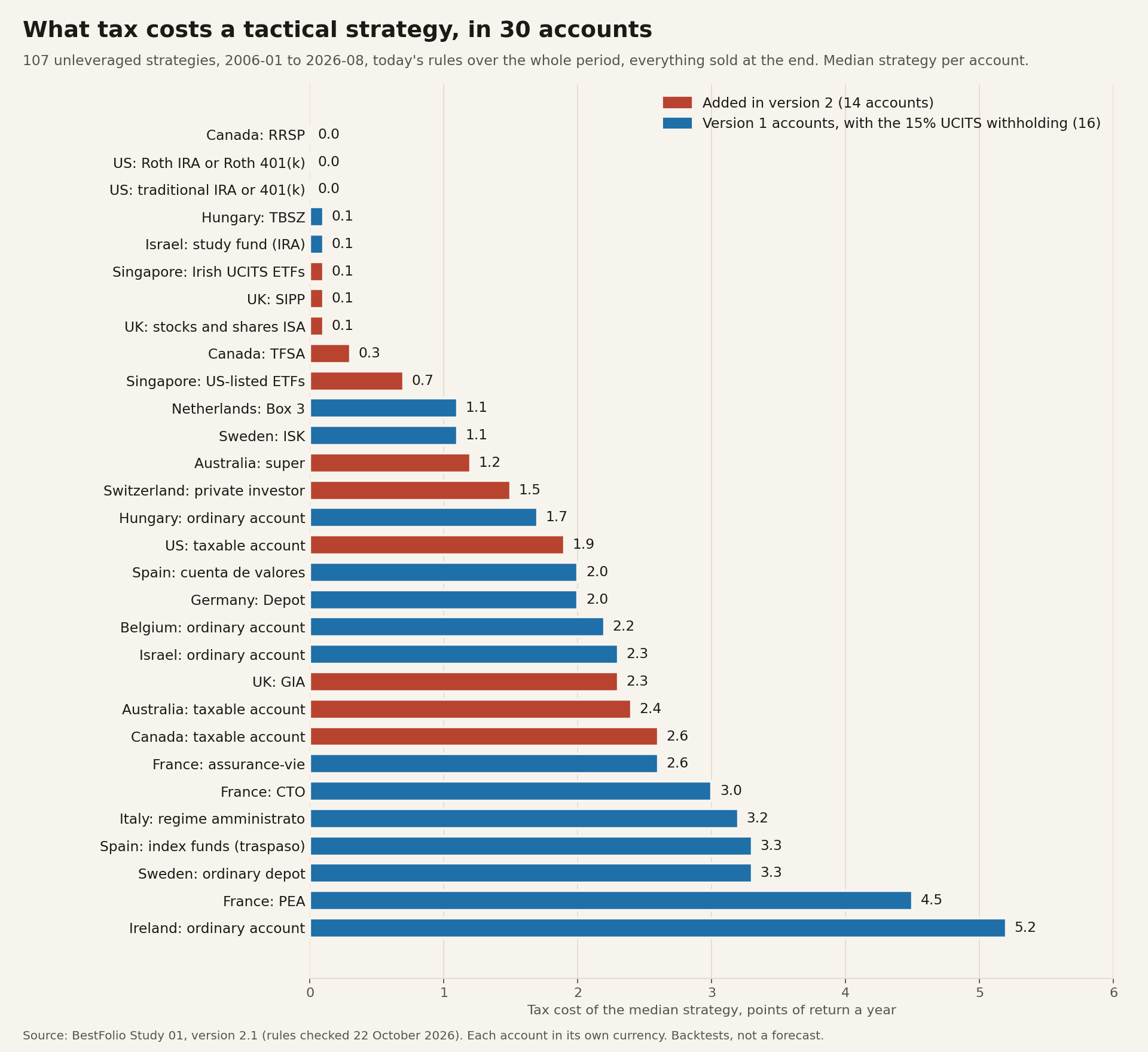
If you invest from the United States, Canada, the United Kingdom, Australia, Switzerland or Singapore, the account you hold a tactical strategy in matters more than the strategy. In an IRA, a Roth, an RRSP, a TFSA, an ISA or a SIPP, tactical allocation keeps almost all of its return. In a taxable account in the US, Canada, the UK or Australia, tax takes 1.9 to 2.6 points a year off the median strategy.
When we published What works where you live on 8 October, it covered 9 European countries and Israel. Many BestFolio members invest from somewhere else, so version 2.1 adds those 6 countries: 14 more accounts, each with its rules in plain words and the primary sources we read them from. There is also a warning scenario for Swiss investors classed as professional traders.
The method is unchanged. We test the same 107 unleveraged strategies, each with the monthly allocations of its backtest, from January 2006 to August 2026. Today's tax rules apply to the whole period, each investor starts with the equivalent of EUR 100,000, and everything is sold at the end, so buy and hold pays its deferred tax too. One thing is new: these accounts also tax or withhold distributions every year, because they hold distributing US ETFs or are taxed on a fund's reported income.
Account by account
| Country | Account | Median strategy, before / after tax | Tax cost a year | Strategies that beat a 60/40 with a smaller fall |
|---|---|---|---|---|
| United States | Taxable | 8.9% / 7.1% | 1.9 points | 41 of 107 |
| United States | Traditional IRA or 401(k), Roth | 8.9% / 8.9% | 0 | 50 |
| Canada | Taxable | 10.1% / 7.6% | 2.6 points | 23 |
| Canada | TFSA | 10.1% / 9.8% | 0.3 points | 36 |
| Canada | RRSP | 10.1% / 10.1% | 0 | 31 |
| United Kingdom | General investment account | 10.5% / 8.1% | 2.3 points | 2 |
| United Kingdom | ISA, SIPP | 10.5% / 10.3% | 0.1 points | 5 |
| Australia | Taxable | 9.4% / 7.0% | 2.4 points | 7 |
| Australia | Super (accumulation) | 9.4% / 8.1% | 1.2 points | 7 |
| Switzerland | Private investor, Swiss broker | 6.7% / 5.2% | 1.5 points | 36 |
| Singapore | Irish UCITS ETFs | 7.7% / 7.6% | 0.1 points | 47 |
| Singapore | US ETFs | 7.7% / 7.1% | 0.7 points | 48 |
Returns are a year, in each account's currency, so compare within a row, not across rows. The Swiss professional-trader case is a warning scenario, not an account you choose, so it is not in the table or in any count (more on it below).
4 things the new countries add
1. The retirement account is where a switcher belongs. In a US IRA or Roth, a Canadian RRSP, a British ISA or SIPP, switching is not taxed. The ISA and the SIPP still lose 0.1 points a year to the 15% US withholding inside the Irish funds that UK investors have to use. For the pension accounts we show untaxed growth: with the same tax rate when you contribute and when you withdraw, the deduction and the tax at withdrawal cancel out. The limits are the catch (USD 7,500 a year in an IRA, GBP 20,000 in an ISA), so most investors will hold their strategy across a sheltered and a taxable account. Many 401(k) plans also only offer a fixed menu of funds, not ETFs, so check yours.
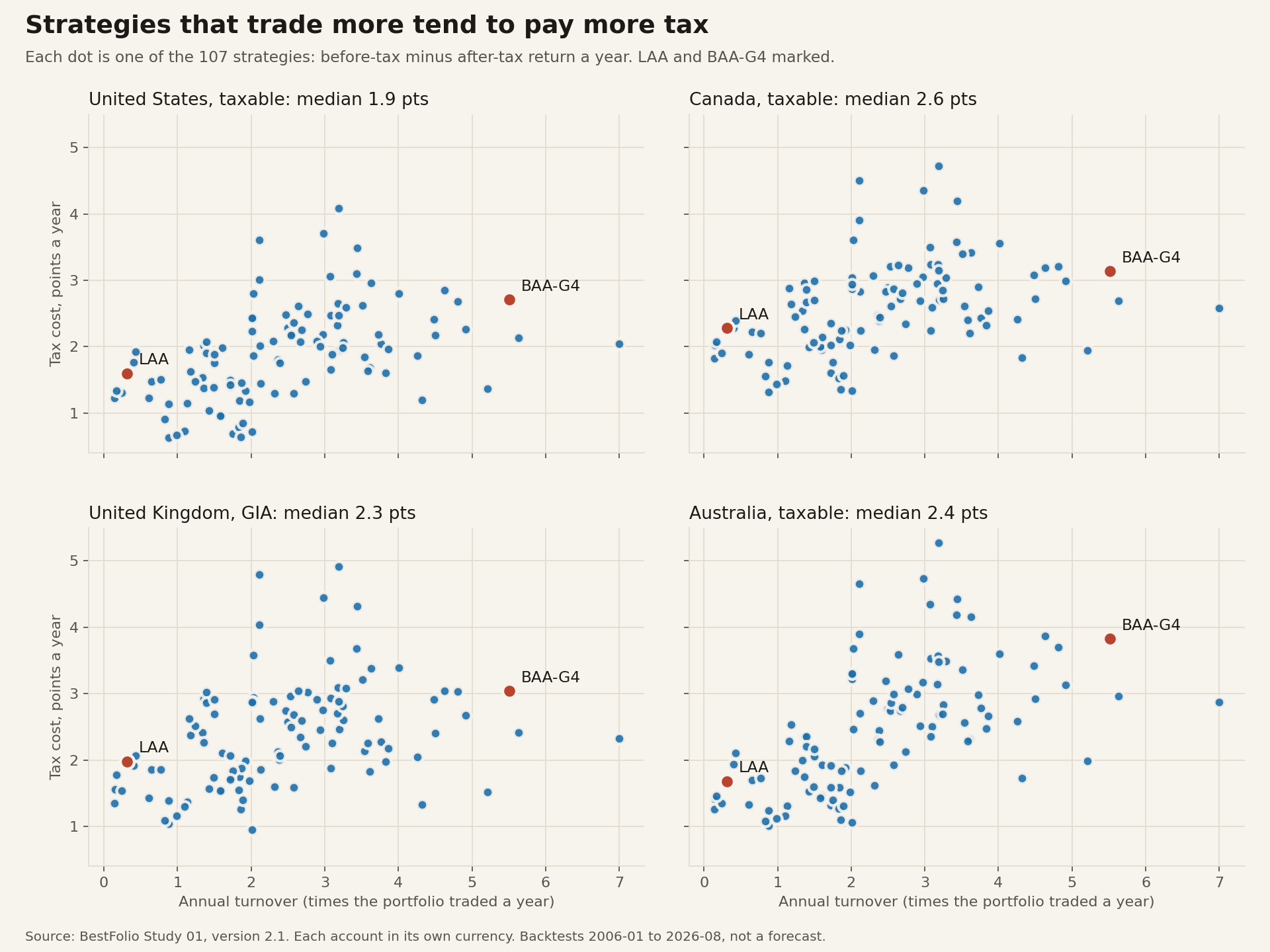
2. In a taxable account, the holding period matters. The US taxes a gain held one year or less as income (24% for our investor) and a longer one at 15%; Australia halves the gain on anything held at least 12 months. That widens the gap between slow and fast strategies. In an Australian taxable account, BAA-G4 (annual turnover 5.5) drops from 39th of 107 before tax to 61st after tax, while LAA (annual turnover 0.3) rises from 45th to 25th. A US high earner pays 3.1 points a year instead of 1.9.
3. Where gains are not taxed, the cost moves elsewhere. A Swiss private investor pays no tax on gains. But a Swiss broker charges 0.15% stamp duty on every buy and every sell of a foreign ETF, and dividends are taxed as income: 1.5 points a year, against 0.7 through a foreign broker. A Singapore investor pays no Singapore tax on gains or foreign dividends. But the US keeps 30% of US ETF dividends (0.7 points a year), and US ETFs are US assets, subject to US estate tax above USD 60,000. Through Irish UCITS funds the cost is 0.1 points and the estate tax question disappears.
4. Your currency changes the yardstick. The pound and the Canadian dollar fell in 2008, which cushioned dollar assets. In a taxable account a 60/40 fell 12% at worst in pounds and 19% in Canadian dollars, against 28% in US dollars. That makes a sterling 60/40 very hard to beat on risk: even in an ISA, only 5 of 107 strategies beat it with a smaller fall, while 28 beat the S&P 500 held throughout.
Same account, a different situation
Each account has a base investor (a single US filer in the 24% bracket, an Ontario resident on CAD 120,000, a UK higher-rate taxpayer, an Australian in the 30% bracket, a Zurich resident on CHF 100,000). The country pages also show what changes when your situation differs:
| Account | What changes | Tax cost a year, base case | Tax cost a year, then |
|---|---|---|---|
| US taxable | High earner (37% and 20%, plus the 3.8% net investment income tax) | 1.9 points | 3.1 points |
| Canada taxable | Frequent trading taxed as business income | 2.6 points | 4.3 points |
| UK GIA | Basic-rate taxpayer | 2.3 points | 1.5 points |
| Australia taxable | Rules from 1 July 2027, ignoring cost indexing | 2.4 points | 2.9 points |
| Switzerland, private investor | Foreign broker, so no Swiss stamp duty | 1.5 points | 0.7 points |
| Switzerland, private investor | Classed as a professional trader (warning scenario) | 1.5 points | 3.3 points |
| Singapore, US ETFs | Bond-fund distributions exempt from US withholding | 0.7 points | 0.3 points |
What survives, across all 30 accounts
Tax barely reorders the top: in each of the 14 new accounts, the 5 best strategies before tax are still the 5 best after tax. What tax does is push the fast strategies down and the slow ones up. Across all 30 accounts, Equity + Managed Futures holds up in 27, LAA in 26 and Five-Asset Momentum Rotation in 24. The 3 GGCEM versions also hold up in up to 25; the study page explains why we leave them out of this list. At the other end, VAA-G4, KDA Top 4, Multi-Asset Momentum and FAA (annual turnover 7.0, 5.2, 4.3 and 3.8) hold up in none.
2 risks the numbers cannot show
Several tax authorities can treat frequent trading as a business. Switzerland's safe harbour for private investors requires holdings of at least 6 months, and 104 of the 107 strategies sell positions sooner. Missing it does not decide the case, because the tax office weighs all the circumstances. But if it classes you as a professional securities dealer, our warning scenario costs 3.3 points a year instead of 1.5. In Canada, the CRA can tax frequent trading as business income: 4.3 points instead of 2.6 in a taxable account in our test. A trading business carried on inside a TFSA makes it taxable. Singapore's IRAS can tax gains as trading income too, looking at frequency, holding period and intention. Neither the CRA nor IRAS publishes a threshold.
Rules also change. Australia replaces the 12-month discount on 1 July 2027 with inflation indexing of the cost and a 30% minimum tax on gains (Act No. 49 of 2026). Ignoring the indexing, the taxable account then costs 2.9 points a year instead of 2.4 in our test.
One correction for Europe and Israel
Irish and other European UCITS funds pay 15% US withholding on the dividends of the US shares they hold, and cannot reclaim it; a US-listed ETF does not. Version 1 left that out. It is now counted in every account that holds UCITS funds, so the figures of the first 16 accounts moved. The tax cost of the median strategy rose by about 0.1 point a year (Germany 1.9 to 2.0, Italy 3.1 to 3.2, Ireland 5.1 to 5.2), and the S&P 500 held throughout lost about 0.3. Strategies that hold US shares less often lose less, so a few more of them now beat a 60/40 with a smaller fall. US real estate funds are counted at the same 15% treaty rate, although whether it applies to a fund's REIT dividends is not confirmed. The study page lists every account before and after.
Read your country
Each country page has every account's rules, the sources and the date we checked them: United States, Canada, United Kingdom, Australia, Switzerland, Singapore. Pro members can rank every strategy in their own account, with the S&P 500 and the 60/40 of that account as rows. The table downloads as a CSV, with a decimal comma if your Excel expects one. Set your account under Settings, Where I invest, and each strategy page shows what your account does to it (the figures are part of Pro).
This is backtest research on published strategies, not tax advice. If a rule on these pages is wrong or out of date for you, tell us: the study is versioned and we fix it.