A good question came up on r/LETFs last week. Say you run a tactical portfolio that reliably steps out of equities, but your indicators are monthly, or 200-day, and they lag. What do you hold in the rest of the portfolio so that a fast crash doesn't hurt too much before the signal fires?
People answered with the usual suspects: gold, long treasuries, managed futures, tail-risk funds, cash. All of these have folklore attached. We wanted the actual numbers, so we measured each one inside the five fastest equity selloffs of the ETF era: the August 2011 US-downgrade break, the February 2018 Volmageddon, the COVID crash, the August 2024 yen-carry unwind, and the April 2025 tariff shock.
Two different problems wearing one name
First, a distinction that changes the whole answer. A true flash crash (the 2024 yen unwind, 2025's tariff week) is over in days. A fast bear (March 2020) takes 4-5 weeks. A monthly-signal TAA strategy will sleep through the first kind entirely and catch the tail end of the second. So the question is really: what cushions the portfolio during a 1-day to 5-week gap?
The five windows
Peak-to-trough total returns inside each fast leg. "n/a" means the fund didn't exist yet.
| Window | S&P 500 | Gold (GLD) | 7-10y (IEF) | 20y+ (TLT) | T-bills | Managed futures (DBMF) | Anti-beta (BTAL) |
|---|---|---|---|---|---|---|---|
| Aug 2011 (downgrade) | -16.6% | +7.0% | +4.5% | +10.3% | 0.0% | n/a | n/a |
| Feb 2018 (Volmageddon) | -10.1% | -2.4% | -1.2% | -3.8% | 0.0% | n/a | +1.3% |
| Feb-Mar 2020 (COVID) | -33.7% | -3.6% | +6.4% | +14.2% | +0.6% | -6.6% | +8.9% |
| Aug 2024 (yen carry) | -6.1% | -1.8% | +2.1% | +4.6% | +0.1% | -7.3% | +6.4% |
| Apr 2025 (tariff) | -12.1% | -4.5% | -0.4% | -3.4% | +0.1% | -2.5% | +3.6% |
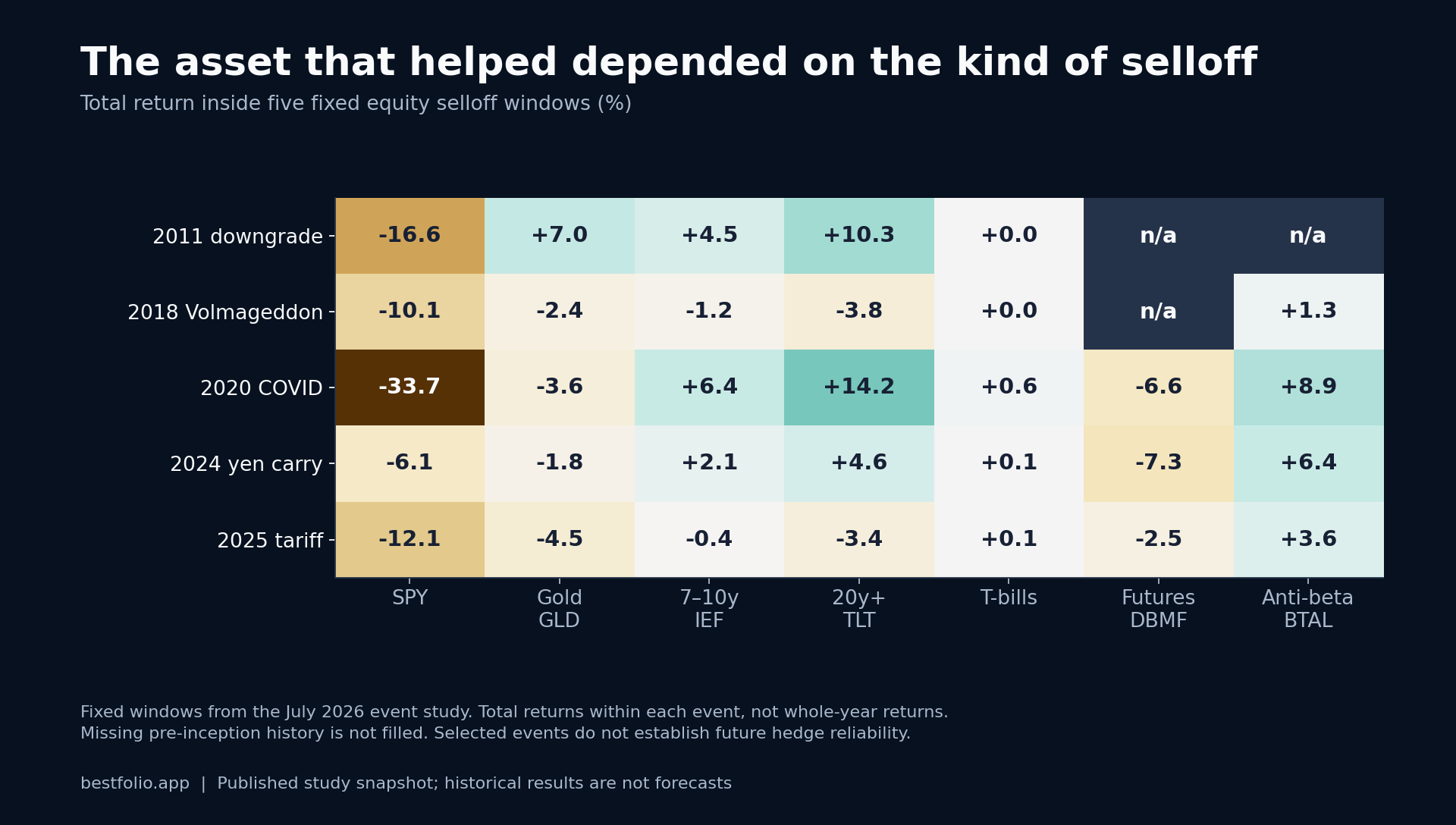
We wrote down three expectations before running this, to keep ourselves honest. Here's how they survived contact with the data.
Treasuries are the most reliable cushion, in growth scares. Confirmed, with a sharper edge than we expected. Duration paid handsomely in 2011, 2020 and 2024. But in the two selloffs with a rates-and-inflation tint (Volmageddon and the tariff week), long treasuries fell alongside stocks. Three saves out of five, and you don't get to pick which regime your crash arrives in.
Gold is a coin flip inside any single fast window. The data killed this one, and not in gold's favor. Gold was down in 4 of the 5 windows. It rallied only in 2011, and in March 2020 it fell 3.6% while stocks crashed, because in a liquidity event people sell what they can, including gold. Gold's 21-year CAGR is over 10%, so it earns its place across regimes. Inside a fast crash, it has mostly been another thing going down.
Managed futures don't spike in a flash crash. Confirmed, cleanly. DBMF was negative in all three windows it existed for. Trend followers need time to turn, and a fast crash is by definition faster than their turn. Their value shows up in the multi-month bear (2022), never in the multi-day one.
The surprise, and its price tag
One asset rose in every single window it existed for: BTAL, the anti-beta fund (long low-beta stocks, short high-beta). Up in Volmageddon, up 8.9% in COVID, up in the yen unwind, up in the tariff week. If all you wanted was something that reliably jumps when equities gap down, this table says BTAL is it.
Here's the bill: BTAL has compounded at -3.8% a year since 2011. Fifteen years of paying roughly 4% annually for the privilege of those crash weeks. That is what reliable convexity costs, and it's why "just hold the hedge that spikes" isn't a strategy. Over the same period T-bills paid +1.6% a year and cushioned exactly zero percent less in the average month.
Sizing the buffer for a lagging signal
Here's the practical takeaway for TAA investors. Your worst case is the crash that starts the day after your monthly rebalance went risk-on. That bounds your exposure: one month of equity beta on whatever fraction of the portfolio is risk-on. The table says the honest cushions for that gap are boring: t-bills never flinched, intermediate treasuries helped in 3 of 5, and everything more exotic either bleeds year-round (BTAL) or arrives too late (managed futures).
If that one-month exposure still keeps you up at night, the fix is a smaller offensive sleeve or a faster signal, and each has its own cost. This is also the design logic behind capital-efficient stacking: strategies like SmartStack keep gold and managed futures in the portfolio permanently for the slow regimes, instead of pretending they'll save the fast week.
Want to stress-test your own mix? The drawdown analyzer shows any ETF portfolio's behavior through each of these windows. Related: the catastrophe brake for leveraged portfolios.