Leveraged ETFs (2x or 3x the S&P 500) multiply your gains in good years and your losses in bad ones. Because they reset every day, a long grinding downturn does lasting damage: lose 80% and you need a 400% gain just to break even. The popular "leveraged risk-parity" mixes (an S&P LETF plus long-term Treasuries plus gold) soften the blow, but in a 2000-style bust or in 2008 they still got hammered.
So we tested the simplest protection we could think of, and we want to be upfront: it is not our invention. It is Meb Faber's 10-month moving-average timing rule (2007), the same absolute-momentum idea behind Gary Antonacci's Dual Momentum, and on the leverage side it is the "run an SMA filter on UPRO or TQQQ" approach that the r/LETFs community has discussed for years.
The rule
If the S&P 500 closes the month below its 10-month average for three months in a row, move the whole portfolio to cash. Move back in the first month it closes back above the average. That is the entire rule, checked once a month.
The only thing we changed is the three-month confirmation. The textbook version bails the first month below the average, which whipsaws: it sells you out of ordinary dips and you miss the bounce. Waiting three months means the brake only trips in real, drawn-out bear markets, not noise. You give up the first leg of a crash on purpose; in exchange you skip the part that does permanent damage. Historically it sits in cash only about one month in eight.
What it does
We added "+ Catastrophe Brake" versions of four popular leveraged portfolios and tested each over its full history. Leverage is modelled with a calibrated cost model, so these figures sit a touch below the cheap-leverage backtests you see elsewhere.
| Portfolio | Worst drop, plain | Worst drop, braked | Return, plain | Return, braked |
|---|---|---|---|---|
| SSO / ZROZ / GLD (2x) | -50% | -36% | 12.3% | 13.7% |
| UPRO / ZROZ / GLD / KMLM | -58% | -41% | 13.4% | 14.9% |
| UPRO / ZROZ / GLD (3x) | -69% | -49% | 14.4% | 16.9% |
| Regime Detector (leveraged) | -84% | -56% | 15.4% | 17.8% |
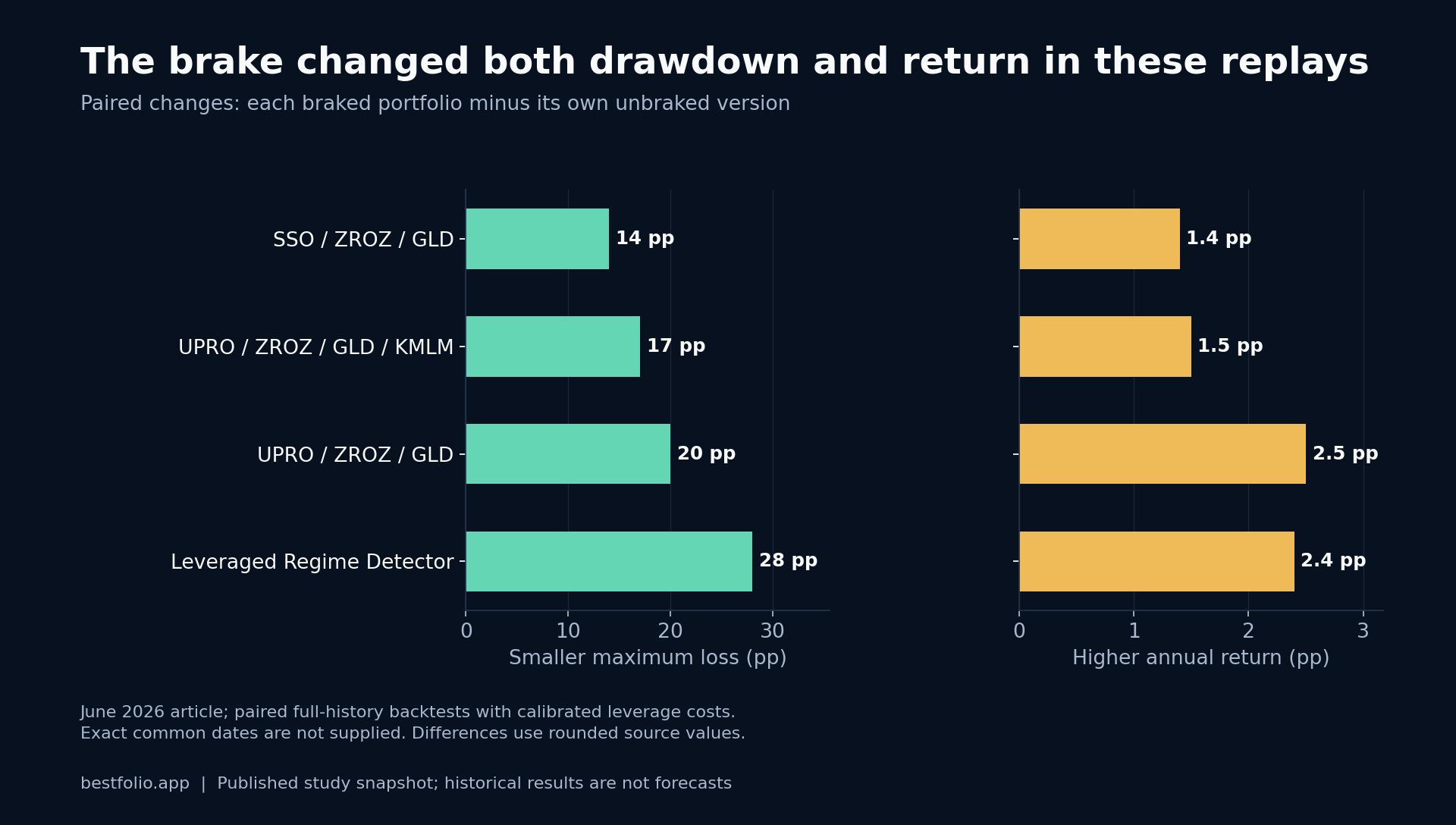
In every case the brake cut the worst fall by roughly 15 to 28 percentage points, and in every case it also raised the long-run return, because dodging the deep holes leaves more to compound.
Why it works
In a long bear market, leverage is your enemy: every month down, the daily reset and the monthly rebalancing dig the hole deeper. Sitting in cash for the duration of those rare, multi-year declines is where almost all of the benefit comes from. You are not trying to be clever or to call the exact top; you are stepping aside when the market is clearly broken and stepping back when it heals.
The honest caveats
- It is late by design. You still take the first 30 to 40% of a fast crash before three months of confirmation arrive.
- It cannot make a 3x buy-and-hold safe. A naked triple-leveraged fund still has a brutal tail; the brake helps, but it is not magic. The cautionary extreme is Jason Kelly's 9Sig, a 3x Nasdaq system with no cash exit: the faithful backtest loses 99.7% peak to trough.
- It only helps portfolios that stay fully invested. Strategies that already rotate to cash or bonds on their own do not need it.
- Leverage before about 2010 is modelled, not live, so treat the deep history as a careful reconstruction rather than a live track record.
The braked versions run on a once-a-month check we publish for you, so there is nothing to watch day to day. Hold them as a calmer way to own leverage, or line them up next to the plain versions and judge for yourself.