"2x VT, do we have this yet?" got asked on r/LETFs again this week. It's one of the most recurring requests in leveraged-ETF land, and the answers are always a list of tickers with no comparison behind them. So here's the comparison, with 18 years of data behind it.
Four realistic routes to levered global equity. They differ on almost every axis that matters: what gets levered, how the leverage resets, what it costs, and who can buy it.
WLDU: the literal answer
WLDU (Leverage Shares) is 2x the daily return of VT itself. Expense ratio 0.75%, listed on Cboe BZX. It's the only product on this list that actually contains emerging markets and small caps at 2x.
The catch is the phrase "daily return". Like every daily-reset product, its long-horizon result is the compounded path, not 2x the index's total return, and the leverage is not cheap. WLDU gets its exposure through total return swaps, and its swap schedule for 31 July 2026 shows it paying the overnight bank funding rate plus 2.00% to 2.50% on the full 200% notional, not just on the borrowed half. The cash rate mostly washes out against the collateral; the spread does not, and it costs about 4.2% of the fund a year on top of the 0.75% fee. The issuer's own literature calls it a short-term trading vehicle.
We simulated the structure with our leverage cost model (the same stack that reproduces real UPRO within 0.3pp a year over 17 years): 2x daily VT, 0.75% ER, financing at Fed Funds plus 50bps on the borrowed notional. From VT's mid-2008 inception through July 2026, the sim compounds at 10.7% a year against 8.9% for plain VT. Read that again slowly: double the exposure bought 1.8 points of extra CAGR, not double the return. The naive dream of "2x of 8.9%" sits about 7 points a year above what the structure delivers, and the gap is the reset, the financing (Fed Funds averaged 1.4% over this window and is meaningfully higher today) and the fee. The worst drawdown along the way: -80%, versus -50% for VT itself.
That financing assumption is too generous for WLDU. Fed Funds plus 50bps on the borrowed half adds about 0.5% a year above the cash rate; WLDU's contracts add about 4.2%. So the sim understates WLDU's cost by about 3.7 points a year. Rerun at WLDU's filed terms, the same daily 2x VT compounds at about 6.4% a year from June 2008 to September 2026, behind plain VT's 8.8% over that window, with the same -80% drawdown.
LVWC: the UCITS cousin
European investors got their version in September 2025: Amundi's MSCI World 2x Leveraged UCITS ETF (LVWC on Xetra), TER 0.60%. Same daily-reset math, one important difference in the underlying: MSCI World is developed markets only. No emerging markets, so it's closer to a 2x developed-world blend than a 2x VT.
For UCITS investors this is still notable, because the older levered UCITS lineup was almost entirely single-country (2x S&P, 2x Nasdaq, 2x DAX). A one-ticker levered developed-world position simply did not exist until last autumn.
RSSB: 2x notional, but read the label
RSSB (Return Stacked Global Stocks & Bonds, ER 0.39%) shows up in every one of these threads, and it's doing something structurally different. It holds roughly 100% global equity plus 100% US treasury futures. So yes, $1 buys $2 of exposure, but the second dollar is bonds, not stocks. It's a levered 50/50 portfolio, not a levered VT.
That's the whole point of the design: it bets that stocks plus duration at 2x beats stocks alone at 2x on a risk-adjusted basis, the way NTSX's 90/60 does for the S&P. But if what you wanted was double the equity beta, RSSB will disappoint you in a melt-up and pleasantly surprise you in a growth scare. Know which trade you're making. And because the bond sleeve is futures-based, the negative-carry question (financing cost vs bond yield) lives here too... 2022 was exactly that scenario, and you can see it in the table below.
NTSX + NTSI: the control-freak option
The fourth route is two WisdomTree efficient-core funds: NTSX (90% S&P + 60% treasury futures, ER 0.20%) plus NTSI (same wrapper, developed ex-US, ER 0.26%). Blend them at your preferred US/international split and you get about 1.5x with full control of the regional mix. Lower octane than the 2x products, no daily reset on the equity sleeve, and the cheapest fee structure of the group.
One nuance that surprised a thread participant this week: NTSI's bond overlay is still US treasury futures. The international diversification you buy is all on the equity side.
The numbers, side by side
All four routes simulated on the same window (June 2008 to July 2026, the longest span VT allows), with financing at Fed Funds + 50bps where leverage is explicit and each product's published ER. That rate is a fair estimate for the futures-based routes; for swap-based WLDU it is far too low, as the correction note at the end explains. RSSB and the WisdomTree funds are synthetic replays of their structures across the full window, since the real funds are younger.
| Route | CAGR | Volatility | Max drawdown | 2022 |
|---|---|---|---|---|
| VT, plain 1x | 8.9% | 20.5% | -50.2% | -18.0% |
| 2x VT daily (WLDU-style, Fed Funds + 50bps) | 10.7% | 41.1% | -80.0% | -38.0% |
| 100/100 stocks+bonds (RSSB-style) | 10.4% | 19.8% | -44.4% | -32.2% |
| 90/60 dev-world (NTSX+NTSI) | 10.2% | 17.2% | -41.0% | -24.2% |
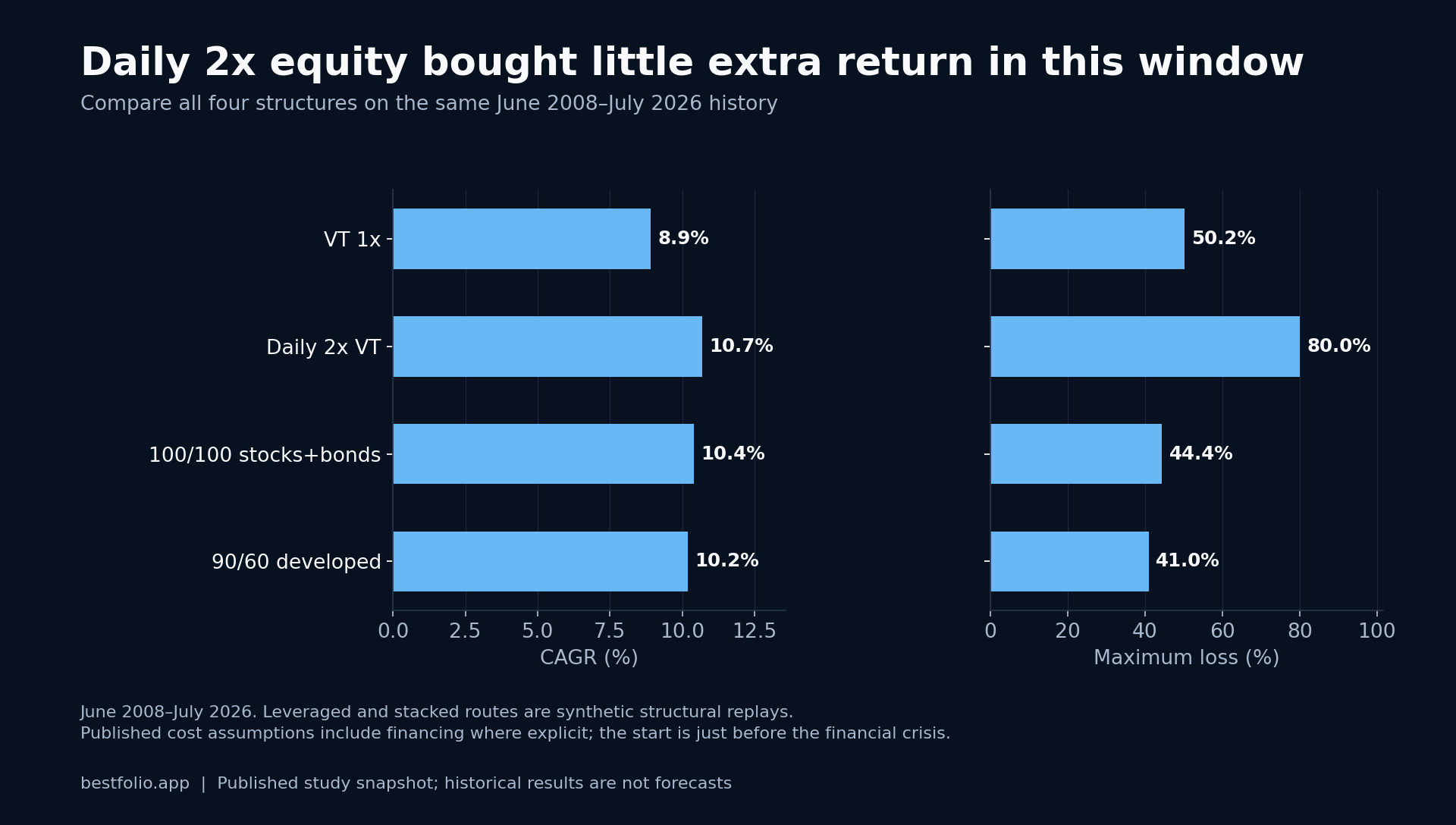
Two honest caveats. The window opens two months before the Lehman collapse, which is close to the worst possible start for a daily 2x product; that's a feature of the test, not a bug, but a 2010 start would flatter WLDU considerably. And the stacked funds carry their own 2022-shaped scar: when stocks and bonds fell together, the 100/100 structure drew down almost twice as much as plain VT. Leverage on bonds is still leverage.
Which one, and whether at all
The table makes the trade brutally visible. The daily 2x route earned 1.8 extra points of CAGR over 18 years in our generic model (at WLDU's real swap terms it would have trailed plain VT) and paid for them with an -80% drawdown and double the volatility. And that's the disciplined version of this trade; push it to a 3x closed system like Jason Kelly's 9Sig and the faithful backtest reads -99.7%. The stacked routes earned nearly the same extra return at a fraction of the pain, because their second dollar of exposure is diversifying instead of doubling down.
Our honest read: for a buy-and-forever holding, the stacked designs have the friendlier math. If you want the full 2x equity ride anyway, the historical difference between holding it naked and holding it behind a simple trend rule is enormous; we quantified that in the catastrophe brake post.
To see how levered exposure fits inside a rules-based portfolio instead of on its own, start with the strategy catalog. European readers: our UCITS substitution guide covers the whole implementation problem, not just this ticker.
Correction, 4 October 2026: an earlier version of this post said WLDU pays financing on the borrowed half at roughly the cash rate, and modeled it at Fed Funds plus 50bps. WLDU's swap schedule for 31 July 2026 shows the overnight bank funding rate plus 2.00% to 2.50% on a 200% notional, about 4.2% of the fund a year in spread alone, so we understated its cost by about 3.7 points a year. The WLDU paragraphs, the table label and the conclusion now say so.