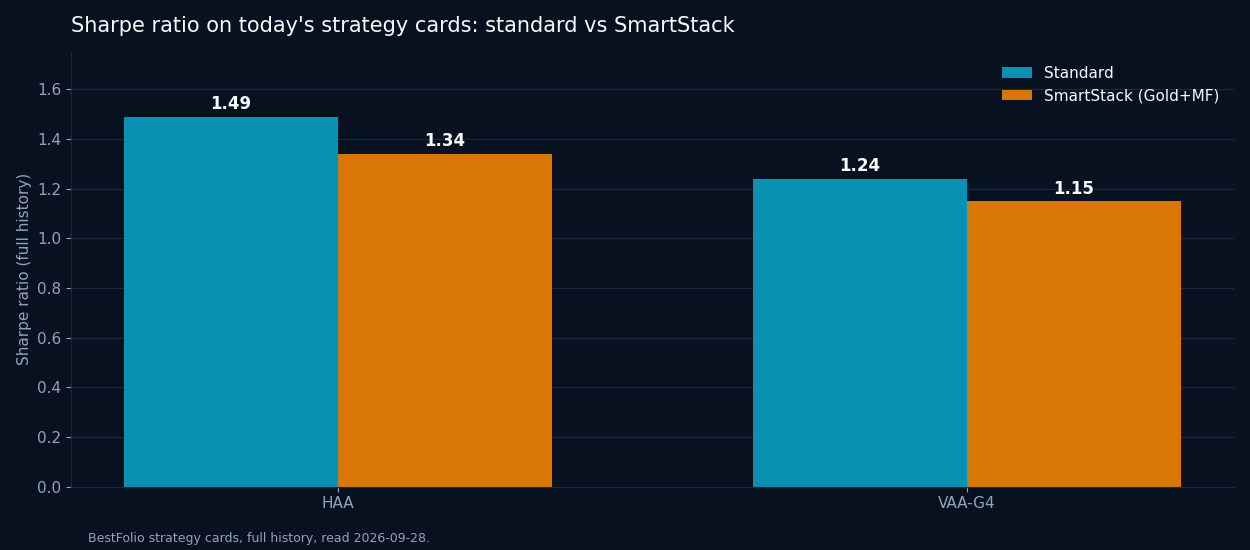
Note (28 September 2026): figures in this post are dated, and two of its conclusions no longer hold on the current backtests. VAA-G4 SmartStack now has a lower Sharpe ratio than VAA-G4 Standard (1.15 against 1.24), and HAA SmartStack a lower one than HAA Standard (1.34 against 1.49). Each strategy page carries the current numbers.
If you have held a classic diversified portfolio — a 60/40, a Permanent Portfolio, or almost any tactical asset allocation strategy — for the last ten years, you have probably felt a nagging sense that diversification has been costing you money.
You are not imagining it. Over the past decade the S&P 500 has returned roughly 14.6% per year. Every dollar you put into gold, bonds, or a managed-futures sleeve was a dollar you did not have in the biggest equity bull run since the 1990s. That feeling has a name: the diversification tax, and for most DIY investors it has been punishing.
Here is the thing most people get wrong about this. The tax is not actually a property of diversification. It is a property of how we have been taught to pay for it: by selling equities to buy something else. A new piece of institutional research just spelled this out in detail — and it happens to describe exactly what we have been building at BestFolio.
Why Classic Diversification Has Felt Like a Tax
Think about how a 60/40 portfolio works. You hold 60% stocks and 40% bonds. When stocks rip, you rebalance out of stocks to bring the weight back to 60%. When stocks fall, you rebalance into stocks. Over a 14.6%-a-year equity decade, that means the 40% you held in bonds was permanently missing from the upside.
Adding gold, managed futures, or alternatives to the mix has the same problem, just redistributed. Every new sleeve has to be funded by cutting something else. If the thing you are cutting is equities, and equities are running, the math goes the wrong way.
This is why so many articles in the last few years argued that "diversification is broken" or that managed futures and gold are "drags on portfolios." They are not drags on portfolios. They are drags on portfolios that fund them by selling equities. It is the funding method that is broken.
What Institutional Research Just Confirmed
In March 2026, Quantica Capital — a Zurich-based systematic investment manager — published a research note called "If You Can’t Beat It, Stack It: How Portable Alpha Overlays May Enhance Equity Returns." The paper is dense, but the idea at the center of it is simple:
What if you did not sell your equities to diversify? What if you kept 100% equity exposure and layered a diversifier on top?
Quantica ran the math on eight candidate diversifiers layered on top of the S&P 500 using capital-efficient instruments like futures. Over the last ten years, their numbers are striking:
- Stacking gold on top of the S&P would have added roughly +5.2% per year without meaningfully increasing portfolio risk.
- Stacking managed futures would have added roughly +1.7% per year, with the added bonus of positive performance during equity drawdowns.
- Stacking Long Volatility — the "tail hedge" favorite — would have destroyed returns because the insurance premium is too expensive to hold continuously.
The conclusion the paper arrives at is this: the right question to ask about a diversifier is not "does it beat equities on its own?" — almost nothing has. It is "can I stack it alongside equities without increasing my risk?" Measured that way, gold and managed futures are the two clear winners.
This Is Exactly Why We Built SmartStack™
Quantica’s approach assumes you have access to futures contracts or total-return swaps — the kind of infrastructure an institutional allocator has. Retail investors typically do not. So when we built SmartStack™, we asked: how do we get the same outcome using only what a normal brokerage account can hold?
The answer turns out to be elegantly simple. Leveraged ETFs at fractional weight.
Here is the trick. Holding UPRO (3x S&P 500) at 33% of your portfolio gives you roughly the same equity exposure as holding SPY at 100%. But it only uses 33% of your capital. That leaves 67% of your capital free to hold something else — in SmartStack’s case, a 50/50 split between GLD (gold) and KMLM (managed futures).
Notice what this accomplishes: you are long 100% S&P equivalent and long ~67% worth of gold and managed futures at the same time. Same account. No margin. No futures. No options. It works in a standard brokerage and, via UCITS substitutes, it works in a European brokerage too.
Under the hood, SmartStack’s overlay engine walks through a base strategy’s allocation and applies a priority ladder:
- Return-stacked ETFs first. Where a purpose-built product already does the stacking (LQD → RSBT, which wraps investment-grade bonds and managed futures in one ticker), we use it directly.
- 3x leveraged ETFs at 1/3 weight. SPY → UPRO, QQQ → TQQQ, TLT → TMF. Same exposure, frees two-thirds of capital.
- 2x leveraged ETFs at 1/2 weight. VNQ → URE, VEA → EFO, etc. Used where a 3x version does not exist. Frees half of capital.
- Synthetic overlay for assets with no leveraged equivalent (DBC, AGG, BND): keep the base position at full weight and add a managed-futures overlay on top.
- Cash and the rest pass through unchanged.
Every unit of capital freed by steps 2 and 3 gets split 50/50 into GLD and KMLM. Those are, not coincidentally, exactly the two diversifiers Quantica’s paper identifies as the most efficient equity overlays.
And We Stack on More Than Just the S&P
Here is where SmartStack goes one step further than the institutional framework. Quantica’s paper studies stacking overlays on top of a 100% S&P 500 allocation. That is a static base. SmartStack applies the same logic on top of any TAA strategy in the BestFolio library.
When you apply SmartStack to HAA, you are not stacking gold and managed futures on top of the S&P 500 — you are stacking them on top of a dynamic nine-asset rotation that already moves defensive in bear markets. When you apply it to VAA-G4, you are stacking on top of a breadth-momentum strategy with a 100% cash defensive mode that sidestepped 2008 and 2022 almost entirely.
The base strategy provides regime-awareness. SmartStack provides persistent, structurally diversifying return streams layered on top. You get both.
The Numbers
Every SmartStack variant sits alongside its standard version on the strategy page, so you can compare them side by side. Here are four of the clearest examples from our full-history backtests (source: BestFolio strategy catalog):
| Strategy | Variant | CAGR | Max DD | Sharpe |
|---|---|---|---|---|
| HAA | Standard | ~14.5% | -18.5% | 1.15 |
| SmartStack (Gold+MF) | 17.4% | -18.8% | 1.17 | |
| VAA-G4 | Standard | 13.3% | -20.6% | 0.97 |
| SmartStack (Gold+MF) | 19.4% | -18.6% | 1.16 | |
| ADM | Standard | 14.3% | -25.8% | 0.90 |
| SmartStack (Gold+MF) | 17.9% | -23.8% | 1.02 | |
| Composite Momentum | Standard | 12.5% | -20.4% | 1.13 |
| SmartStack (Gold+MF) | 17.5% | -30.4% | 1.07 |
A few things stand out. VAA-G4 SmartStack is the clearest win: every single metric improves simultaneously — CAGR jumps from 13.3% to 19.4%, max drawdown actually decreases, and Sharpe improves meaningfully. That is rare. It happens because VAA-G4’s aggressive defensive posture means the overlay only runs at full intensity during risk-on regimes.
HAA SmartStack is the most elegant: +2.9% CAGR, virtually identical drawdown, and a Sharpe that edges up from 1.15 to 1.17. This is what "free diversification" actually looks like in practice.
Composite Momentum SmartStack (our BestFolio Original) tells a slightly different story. CAGR jumps by 5 points but the drawdown stretches from -20% to -30%. That is the leverage tax from the 3x ETFs showing up in the worst-case episodes. Even so, -30% is less than half of what the S&P 500 experienced in the 2008 financial crisis (-55%) and a fraction of what TQQQ experienced (-79%).
The Honest Caveats
SmartStack is not free money. A few things to keep in mind:
- Leveraged ETFs have decay. Daily rebalancing means they underperform a buy-and-hold at the target multiple over long periods, especially in choppy markets. SmartStack uses them at fractional weight, which reduces the problem but does not eliminate it. Our full-history backtests include these costs.
- Drawdowns can stretch. During the worst episodes, the overlay does not always hedge — gold had its own brutal 1990s, and managed futures can get whipsawed in sharp V-shaped reversals (as 2025 reminded everyone). SmartStack tends to work best when the base strategy already has a defensive mode.
- Gold and managed futures are cyclical. Their diversification benefit is not constant. The last 20 years have been kind to both; the next 20 might not be. Quantica’s paper is careful to note this, and so are we.
- Past performance does not predict future results. These are full-history backtests including the exact ETFs and proxy chains we use today. They are not a promise about what happens next.
How to Explore SmartStack
Every SmartStack variant is live on its base strategy’s page. Open HAA, VAA-G4, ADM, or Composite Momentum, and you will see a "SmartStack" variant toggle next to "Standard." Compare the equity curves, check the full metrics, and look at the current allocation the variant is holding right now.
Pro subscribers get live monthly signals for every variant. If you already run one of these strategies in your own account, switching to the SmartStack version is usually a handful of trades a month.
SmartStack is also available as a building block inside our portfolio builder, so you can combine multiple SmartStack variants into a single execution-ready portfolio with unified analytics. That is the other half of the SmartStack™ story — layering not just return streams, but entire strategies, without losing track of net exposure.
Warren Buffett famously bet that hedge funds could not beat the S&P 500 over a decade. He won that bet. He would likely have won it again over the last decade too. But that framing misses the real question, the one Quantica’s paper finally makes explicit: which strategies can be scaled alongside equities without raising portfolio risk? The answer, in our experience and theirs, is trend following and gold. And the cleanest way for a DIY investor to access both, layered on top of a smart base strategy, is SmartStack.