If you follow r/ETFs or r/Bogleheads, you’ve seen the momentum ETF debate heat up. The main contenders:
- SPMO (Invesco S&P 500 Momentum) – S&P 500 names ranked on risk-adjusted 12-month momentum, semi-annual rebalance, 0.13% ER
- MTUM (iShares MSCI USA Momentum Factor) – 6 and 12-month risk-adjusted momentum blend, semi-annual rebalance, 0.15% ER
- FDMO (Fidelity Momentum Factor) – multi-signal momentum screen on US large and mid caps, 0.15% ER
- QMOM (Alpha Architect U.S. Quantitative Momentum) – quality-filtered, highly concentrated momentum, 0.28% ER
- FMTM (MarketDesk Focused U.S. Momentum) – actively managed, 30 to 50 holdings, monthly rebalance, 0.45% ER, launched March 2025
These are all reasonable products, and SPMO in particular has had a remarkable run: up 45.8% in 2024 and 18.9% a year since its 2015 launch. But there is a limitation baked into every one of them that tactical momentum strategies do not share.
The problem: momentum ETFs are always long
A momentum ETF rotates within equities. It buys the winning stocks and drops the losers. It never asks the other question: should I be holding equities at all right now?
That distinction does nothing in a rotation year and everything in a systemic one. When the whole market falls together, ranking stocks against each other cannot help you, because the fund is still fully invested by design. Tactical momentum strategies add the second decision, rotating to bonds, gold or cash when broad market trend turns negative.
Head-to-head: the numbers
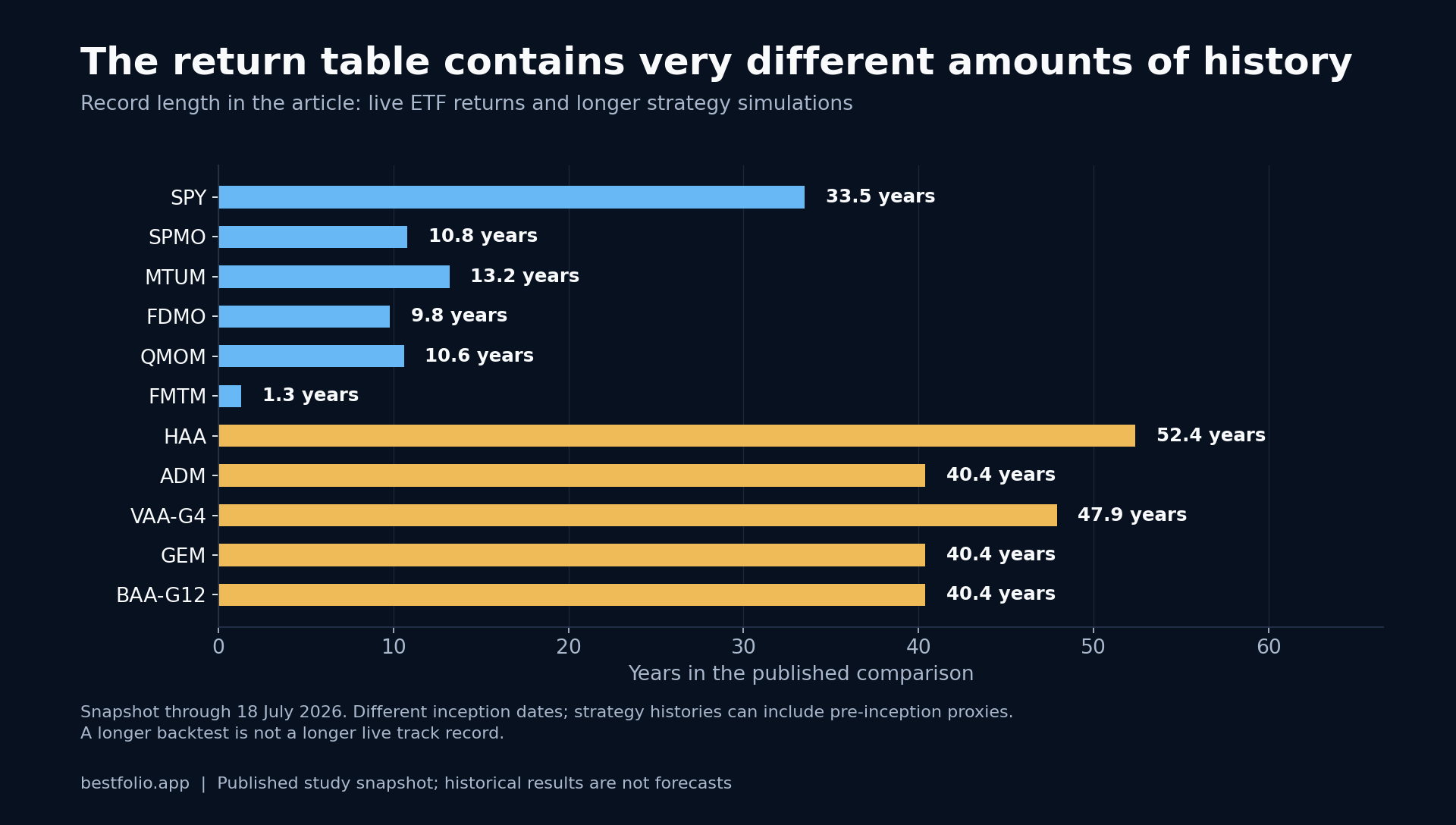
ETF figures are live total returns from each fund’s own inception through 18 July 2026, so the periods are not equal and a fund with a short, friendly sample will flatter itself. Strategy figures are backtested over the full history our data supports.
| Strategy / ETF | CAGR | Max DD | Sharpe | Vol | Years |
|---|---|---|---|---|---|
| Momentum ETFs (buy and hold, live records) | |||||
| SPY (S&P 500 benchmark) | 10.8% | -55.2% | 0.50 | 18.6% | 33.5 |
| SPMO (since 2015) | 18.9% | -30.9% | 0.85 | 20.3% | 10.8 |
| MTUM (since 2013) | 15.7% | -34.1% | 0.74 | 20.0% | 13.2 |
| FDMO (since 2016) | 15.3% | -33.9% | 0.71 | 19.6% | 9.8 |
| QMOM (since 2015) | 11.4% | -39.1% | 0.46 | 26.3% | 10.6 |
| FMTM (since 2025) very short record | 37.5% | -12.2% | 1.26 | 24.7% | 1.3 |
| Tactical momentum strategies (backtested) | |||||
| HAA (Hybrid Asset Allocation) | 16.3% | -19.5% | 1.49 | 9.9% | 52.4 |
| ADM (Accelerating Dual Momentum) | 15.8% | -25.8% | 1.10 | 14.4% | 40.4 |
| VAA-G4 (Vigilant Asset Allocation) | 16.1% | -20.9% | 1.24 | 11.4% | 47.9 |
| GEM (Global Equities Momentum) free | 13.4% | -33.7% | 1.04 | 14.3% | 40.4 |
| BAA-G12 (Bold Asset Allocation) | 11.4% | -14.3% | 1.28 | 9.0% | 40.4 |
Past performance does not guarantee future results, and backtested strategy results are hypothetical.
Read that table carefully, because the sample lengths are doing work
FMTM sits at the top of the CAGR column with a 37.5% annualised return and a max drawdown of only 12.2%. That number tells you almost nothing yet. The fund started trading on 20 March 2025 and has never seen a bear market, so its worst drawdown so far is really a statement about what has not happened during 16 months.
The same caution applies in smaller doses down the whole ETF list. SPMO’s live record starts in October 2015, which excludes 2008 entirely. MTUM starts in 2013. None of them contain a genuine full cycle, and the one crash they share, COVID, was over in five weeks.
The fairest comparison available is the window all of them have lived through together. Since FMTM’s inception, SPMO has returned 54.3%, FMTM 52.5%, FDMO 42.4% and SPY 33.7%. On the same dates, in other words, the actively managed newcomer has trailed the cheapest passive momentum fund in the group by a small margin, while costing more than three times as much.
The FMTM question
FMTM is the most interesting design of the bunch, and worth pinning down precisely, because the ticker gets mixed up with Fidelity’s FDMO constantly. FMTM is a MarketDesk product, actively managed, holding 30 to 50 US businesses selected on the consistency and quality of their recent price momentum, rebalanced monthly, for 0.45% a year.
The monthly rebalance is a real methodological argument. Semi-annual funds such as SPMO and MTUM can hold six-month-old winners well past the point where momentum has turned, which is exactly what made 2009 so painful for the momentum factor: portfolios were loaded with pre-crisis leaders and took months to rotate out. Monthly reconstitution shortens that lag.
What it cannot do is leave equities. When the next systemic drawdown arrives, faster rotation among falling stocks is still rotation among falling stocks. That is the boundary of the entire ETF category, and it applies to the newest and cleverest member of it exactly as it applies to the oldest.
What stands out
1. Drawdown protection is the real edge
SPMO and MTUM both took 30%-plus drawdowns in the COVID crash and the 2022 bear. HAA held its worst backtested drawdown to 19.5% over 52 years, BAA-G12 to 14.3% over 40. The mechanism is not clever stock selection, it is having somewhere else to go.
2. Risk-adjusted returns separate more than raw returns
SPMO earns its 18.9% by running at 20.3% volatility. BAA-G12 produces 11.4% at 9.0% volatility, and HAA 16.3% at 9.9%. Compare the Sharpe column rather than the CAGR column and the gap between holding a factor and managing exposure to it becomes obvious.
3. Rebalancing frequency matters, but not the way the debate assumes
The argument about monthly versus semi-annual reconstitution is a second-order question. The first-order question is what you rebalance into. Tactical strategies rotate across asset classes; every ETF here rotates within US large-cap equities, whatever its cadence.
4. Blending beats picking
Tactical strategies with different signals tend to fail at different moments, so combining a few uncorrelated ones usually produces a smoother line than any single component. That is a more productive use of attention than optimising which momentum ETF to hold.
When a momentum ETF is the right answer
- Simplicity: buy, hold, no monthly decisions to execute or forget
- Tax treatment: in-kind creation and redemption keeps most internal turnover off your tax bill
- No execution risk: you get what the index delivers, with no chance of missing a signal
- You want the tilt, not the exit: if the plan is to hold equities through everything anyway, a momentum tilt is a reasonable way to do it
Just size it as an aggressive equity sleeve rather than as protection, because on the evidence of every long momentum dataset we have, protection is the one thing it does not provide.
Explore further
We track 80+ strategies on BestFolio, including every tactical momentum strategy above, with decades of backtested history behind each one. Explore GEM (free) or browse the full library. For the century-long view of what the momentum factor itself does in a crash, see SPMO’s whole crash record and five momentum strategies tested back to 1928. If you hold both a momentum ETF and a tactical strategy, the portfolio overlap calculator shows how much of the same exposure you are actually paying for twice.
Important disclaimer: This article is for educational and research purposes only. It is not investment advice. Backtested results are hypothetical, do not reflect actual trading, and do not guarantee future performance.