Note (24 September 2026): figures in this post are dated. Later data corrections moved some of them; each strategy page carries the current numbers.
Correction (6 September 2026): the Sharpe and Sortino figures in this post were computed under earlier definitions (daily-basis Sharpe before May 2026, losing-month Sortino before September 2026). Every live page now uses one monthly definition described on the methodology page; the strategy pages carry the current values.
The release in one paragraph
Seven new strategies in the catalog today, six of them leveraged. They span the named names in the r/LETFs community (RNAProf, u/Wongkok, u/Low-Initiative-1327), a published author (David Alan Carter), and two house strategies. The point of this writeup is not a sales pitch. It is the rule set, what each one does well, and what breaks it. If you cannot write the failure mode in one sentence, you should not be running the strategy.
A note on leverage before the strategies
Leveraged ETFs are not a free upgrade to higher returns. They are a tool for taking more equity-like exposure on less capital, at the cost of much deeper drawdowns and asymmetric volatility decay. Every strategy below either accepts the deep drawdown directly (you need an iron stomach and a small sleeve), or applies a trend filter that exits before the worst of it (giving up some upside in exchange for clipped downside). Read each shortcomings paragraph before sizing.
We deliberately did NOT include the Kelly 3sig / 6sig / 9sig family in this release. Kelly's quarterly value-averaging system on 3x TQQQ posted a 99.73% peak-to-trough drawdown in the dot-com window in our backtest, and the 6sig 2x variant is in the same family. Those strategies are not catastrophic in every regime, but they fail in exactly the regime most users would want them to survive. We are choosing not to put them in front of the wider userbase yet. Trusted testers can still see them.
1. TQQQ/UPRO Trend SMA
Author: Reddit-community classic. Variations of "TQQQ above the SPY 200-day, otherwise cash" have made the rounds on r/LETFs for years, well before BestFolio existed. Our contribution is the implementation: the QQQ-vs-SPY relative-strength layer for index selection in the risk-on regime, the managed-futures pairing as the structural answer to 2022-style episodes, the defensive basket, and the daily-eval/monthly-rebal mechanics that make it actually runnable. Type: daily-evaluated, monthly rebalance, leveraged equity plus managed futures.
How it works. One signal, two layers. SPY's 200-day SMA decides risk-on vs risk-off. When SPY is above its 200-day, a second filter compares QQQ's 60-day return to SPY's 60-day return. If Nasdaq is winning, 35% of the portfolio goes into leveraged Nasdaq (25% TQQQ, 10% UPRO) and 65% into managed futures (CTA, KMLM). If S&P is winning, the leveraged-equity weight comes off and the strategy holds 50% CTAP plus 50% MATE (capital-efficient managed futures wrappers that pair stacked exposure with trend). When SPY falls below the 200-day, the strategy goes defensive: 30% managed futures, 10% leveraged gold (UGL), 60% bonds and low-vol equity.
Merits. The double filter keeps you out of the obvious LETF traps. You do not ride TQQQ through 2000-2002, 2008, or 2022. The managed-futures pairing in the equity regime is the structural answer to the 2022-style episode where leveraged stocks and leveraged bonds fall together. CTA/KMLM trended hard up in 2022 while UPRO and TMF were imploding.
Shortcomings. The QQQ-beats-SPY filter is a momentum-on-momentum bet, chasing recent winners. In a sharp leadership rotation (small caps suddenly leading, value coming back), the strategy is slow to switch. The defensive regime holds long-duration bonds, which got hammered in 2022 alongside everything else. And backtests are deeply in-sample for the post-2010 era where Nasdaq plus managed futures has been a great pairing. Outside that regime, less certain.
Variants. Two variants ship. Standard (16.92% CAGR / -42.64% MaxDD) uses the actual leveraged-ETF universe (TQQQ, UPRO, CTA, KMLM, CTAP, MATE) and is the variant the live signal runs on. testfol.io Proxy (20.30% / -42.64%) uses testfol.io's 1A asset decomposition (synthetic 3x SPY and 3x Nasdaq series, plus modeled managed-futures proxies) and exists for cross-validation against community backtests run on that site. The Standard MaxDD is identical to the Proxy because both hit the worst drawdown in the same regime (2000-2002) where the trend filter exited late.
2. Low Initiative LETF V2
Author: u/Low-Initiative-1327 (r/LETFs, 2026). Type: daily-evaluated tactical with three states.
How it works. Two signals, three states. Signal A: is SPY above its 200-day SMA plus 4%? Signal D: is VIPSX (a TIPS fund used as a macro-inflation proxy) below its 200-day SMA by 4%? If A is true, the strategy holds a leveraged risk-on basket (leveraged equity, gold, long bonds). If B (SPY below 200-day minus 4%) or D is true, it shifts to risk-off (intermediate bonds, gold, managed futures). The no-man's-land in between holds 100% SPY as an unleveraged fallback. The TIP signal is asymmetric: it can push you OUT of leverage, but it cannot pull you in.
Merits. The plus-or-minus 4% SPY buffer cuts whipsaw at the 200-day boundary. The TIP-inflation kicker is thoughtful: it tries to detect macro stress (inflation surprise) before equity weakness shows up in price. Daily evaluation means the strategy responds quickly when conditions change.
Shortcomings. The TIP-as-inflation-signal alpha is heavily concentrated in 2022. The post-2010 backtest looks great partly because that is the one window where the signal triggered correctly into the inflation regime. Our BestFolio implementation uses UGL (real 2x gold) rather than the spec's synthetic 3x gold (no real US ETF), trading roughly 150 bps of CAGR for tradeability. Our backtested CAGR comes in at 15.78%, not the 21.35% claimed by some testfol.io runs of this strategy that use the synthetic ticker. We chose 15.78% real over 21.35% paper.
3. A-RVol Shifter
Author: u/Wongkok (r/LETFs), building on u/XXXMrHOLLYWOOD's earlier SPY-200-SMA work. Type: daily multi-filter shifter.
How it works. A state machine between TQQQ (3x Nasdaq), QLD (2x Nasdaq), and a defensive rotation, driven by QQQ realized volatility. Five inputs: 15-day realized vol on QQQ; the vol ratio (current 15-day versus 252-day trailing average); SPY's 200-day SMA with hysteresis bands; the HYG/LQD ratio change (credit stress proxy from 2007 forward); and a Donchian channel (40-day QQQ low) for price-level exits. The state machine moves you toward more leverage when vol and ratios stay below thresholds, and toward defensive (best-of TLT / GLD / XLU / XLE by momentum) when any single filter trips.
Merits. Multi-filter design reduces dependence on any single signal. The credit-spread input adds a non-price stress detector, which is valuable because credit often moves before equities in a real crisis. Vol-targeting plus trend filter is a well-studied approach to harvesting LETF compounding without eating the worst drawdowns.
Shortcomings. Lots of parameters. Lots of thresholds. The risk of in-sample tuning is high, especially for the credit-spread and Donchian add-ons that look great on the 2007-2009 window because the signals were calibrated against it. Daily evaluation under a three-state machine creates frequent state transitions, which means real-world friction (bid-ask, taxes) is more material than the backtest shows. The defensive rotation uses sector ETFs (XLU, XLE), which adds another correlated bet on top of the macro signals.
Variants. Four variants on the same V3 signal stack. 3-State (V3) is the headline (23.80% CAGR / -62.20% MaxDD / 0.76 Sharpe): TQQQ at low realized vol, QLD in the middle band, defensive when any filter trips. 2-State (V3) drops the QLD intermediate (17.93% / -52.43% / 0.65 Sharpe), so it is either fully leveraged or fully defensive, with more whipsaw in chop. Cash-Only (V3) (24.98% / -38.36% / 0.83 Sharpe) replaces the rotating TLT/GLD/XLU/XLE defensive with BIL, which trades some risk-off return for simplicity and turns out to have the best Calmar (0.65) of the family because the defensive period draws down less. Wongkok 200SMA (25.03% / -60.37% / 0.77 Sharpe) is u/Wongkok's original published spec with no VR, no credit-spread, no Donchian gates, kept in the catalog so the V3 additions can be A/B-compared against the unfiltered original. The V3 filters trade a small amount of upside for a meaningful drawdown reduction; whether that trade is worth it depends on the user's tolerance.
4. RPEA (RNAProf's Excellent Adventure)
Author: u/RNAProf (r/LETFs, 2022). Type: leveraged All-Weather with per-asset SMA timing.
How it works. Nine sleeves: UPRO 32% (timed by SPY's 8-month SMA), MIDU 14% (IJH 4-month), TQQQ 7% (SPY 8-month), EURL plus AVDE 13% (separate VEA / AVDE timing), EDC plus AVEM 13% (EDC / AVEM timing), UGL 10% (gold 2-month vs 12-month SMA crossover), UTSL 11% (utilities, SPY 7-month). Each sleeve is replaced with defensive (TMF, or adaptive, or partial-delever) when its timing signal fails. The strategy is fully levered across asset classes when all signals are green, fully defensive when all are red, and partial when some are green and some red.
Merits. Diversification across geographies (US, Europe, EM) and asset classes (equity, gold, utilities) is rare in LETF strategies, most of which collapse to "leveraged Nasdaq with a bond hedge." Per-asset timing means you do not have to be all-in or all-out. The defensive flexibility (three modes) lets you tune to your comfort level. The mid-cap and EM legs add legitimate diversification rather than just amplifying the US large-cap bet.
Shortcomings. Nine sleeves means nine LETFs to hold, each with daily-reset decay and a 0.90 to 1.10% expense ratio on the 3x funds. The international and EM 3x funds (EURL, EDC) trade thin and carry wide bid-ask spreads, especially on stress days. The strategy has not been tested in a true sustained global-inflation regime; 2022 is one window, not five. SMA-timing risk is real: long-period SMAs (8-month) react slowly, so you can be holding leveraged TQQQ well into a downtrend before the signal flips.
Variants. Four variants, all sharing the per-asset SMA timing across the same universe. Full (9 sleeves) (26.75% CAGR / -76.79% MaxDD) is the canonical implementation: nine leveraged sleeves with TMF as the defensive on each signal failure. The 76% drawdown is the dot-com window where the defensive sleeve (TMF) was also down hard. Simplified (5 sleeves) (30.96% / -76.05%) uses only the most liquid funds (UPRO, TQQQ, EDC, UGL, UTSL); higher CAGR because the concentration is in the strongest sleeves, similar drawdown for the same reason as Full. Adaptive Defense (23.86% / -59.82%) replaces the all-TMF defensive with a TMF / GLD / BIL cascade that picks whichever is actually trending up; trades CAGR for a meaningful 17-point drawdown reduction. Conservative (Partial Delever) (22.17% / -57.08%) is the most practical for real money: when a sleeve goes risk-off, the allocation splits 50% into the 1x underlying (e.g., SPY instead of UPRO) and 50% into the adaptive defense. This is what we run as the reference RPEA. Both Conservative and Adaptive Defense have a meaningful drawdown reduction vs Full / Simplified, at the cost of 4-8 points of CAGR.
5. Buy the Dip
Author: Reddit-community classic. "Buy the dip" RSI plus 200-day SMA timing has been a recurring topic on r/LETFs and r/investing for as long as TQQQ has existed. Our contribution is the implementation: explicit hysteresis bands at the trigger boundaries (so the state machine does not flap), the SQQQ overheating leg that takes the inverse side when RSI runs above 80, the diversified momentum-default sleeve (rather than 100% leveraged Nasdaq in the in-between regime), and a fallback regime for everything else. Type: daily RSI/SMA hysteresis state machine.
How it works. Three regimes by priority on QQQ. Oversold (RSI(14) below 29.7): 100% TQQQ. Overheated (RSI above 80.8): 100% SQQQ, the inverse. Momentum (price above 200-day SMA plus 3%): a balanced risk-on sleeve of 20% TQQQ, 30% managed futures (DBMF), 10% leveraged gold (UGL), 20% low-vol equity (USMV), and 20% long bonds (ZROZ). Fallback (everything else): risk-off, swapping the TQQQ slice for intermediate bonds. Hysteresis bands of about plus-or-minus 0.5 around each trigger reduce whipsaw at the regime boundaries.
Merits. The hysteresis bands are explicit, not implicit, which avoids the classic "in on Monday, out on Wednesday, in on Friday" issue that kills simple RSI strategies in real money. The default risk-on regime is well-diversified, not a pure leveraged-Nasdaq bet. The strategy explicitly takes the inverse side at extreme overheating (SQQQ when RSI greater than 80.8), which most LETF strategies do not.
Shortcomings. Path-dependent strategies are hard to backtest honestly because the state on day N depends on the entire history. Different starting dates can produce meaningfully different return paths, and we are upfront about that on the strategy page. The inverse-LETF leg (SQQQ when overheated) is a structural short with volatility decay against you; it works only if the overheating actually mean-reverts quickly. Holding SQQQ through a slow grind higher loses both ways. And daily rebalancing on a state machine generates frequent transactions, which means taxable accounts pay a real cost.
6. White Knuckle (Carter)
Author: David Alan Carter (published). Type: monthly, leveraged risk parity plus momentum rotation. The spiciest in the release.
How it works. 50% in a leveraged risk-parity core (inverse-volatility weighted across SPXL 3x S&P, TQQQ 3x Nasdaq, TMF 3x long bonds), 50% in a momentum rotation that picks the single best 3-month return from an 8-candidate hedge universe (EUO, IVOL, UUP, USDU, YCS, SPXL, TQQQ, TMF). Monthly rebalance.
Merits. The name is honest. The strategy is what it says: leveraged conviction with a momentum hedge that swings toward whatever is currently trending. Risk parity on the leveraged core keeps the equity-vs-bond balance reasonable rather than letting one sleeve dominate. The hedge rotation gives you a way to be long inverse-yen, USD, or volatility when those are the dominant trades.
Shortcomings. This is the spiciest strategy in the release. There is no trend filter. You hold the leveraged core through everything, including drawdowns. SPXL, TQQQ, and TMF all got hit hard in 2022 (rates up, equities down, all three legs bleeding simultaneously), and the strategy stayed invested. The momentum hedge helps if a single inverse asset trends, but in a chop or a regime shift it whipsaws. Real-world friction on the hedge rotation is high: USDU, YCS, IVOL trade thinly and carry wide spreads. Sleeve sizing is the whole game with this one. Running it as 100% of a portfolio is how people post 70%+ drawdowns and do not come back.
7. Cash Trigger (Carter), the unleveraged companion
Author: David Alan Carter (published). Type: monthly trend-following, no leverage. Included because the Carter family becomes a clean conservative / moderate / aggressive ladder with Cash Trigger, the already-released Carter 12% strategy, and White Knuckle.
How it works. One rule. When SPY is above its 200-day SMA, hold 100% SPY. When SPY is below, rotate to the bond ETF with the best 3-month return from TLT, JNK, MUB, SHY. Monthly rebalance.
Merits. A bog-standard SMA trend rule, but with a bond-rotation defensive that picks whichever bond is actually working rather than locking into one. Surprisingly under-discussed in TAA circles for how simple and well-designed it is. No leverage means no daily-reset decay, no LETF tracking error, no volatility drag. Easy to execute by hand. Good baseline strategy to compare leveraged variants against.
Shortcomings. The 200-day SMA whipsaws in choppy years (2015, 2018, 2020 each cost 5-7% on this kind of signal). The bond-rotation defensive can pick the wrong bond when bonds and equities are both falling. In 2022, the best-3-month-bond rotation pointed at TLT for most of the year, and TLT was the worst bond holding for most of the year. As a standalone, the strategy lags buy-and-hold in long uninterrupted bull markets. Best used as a partial sleeve, not a full portfolio.
Performance, variant by variant
Each strategy ships with one or more variants that share the core rule set but differ in how aggressively they apply it, which assets they hold, or how the defensive side is structured. Here are the headline metrics for all fourteen variants in this release, computed on our backtest engine. CAGR and Max Drawdown are nominal (not real), gross of taxes, with reinvested distributions. Backtest start dates vary because some strategies require asset histories that do not go back to the 1980s (A-RVol Shifter needs HYG, which only starts in 2007; White Knuckle needs MATE-style funds; RPEA Full and Simplified end in April 2026 because those backtests have not been rerun against the latest closes, the other variants have).
| Strategy | Variant | Period | CAGR | MaxDD | Sharpe | Sortino | Calmar |
|---|---|---|---|---|---|---|---|
| TQQQ/UPRO Trend SMA | Standard | 1986-2026 | 16.92% | -42.64% | 1.01 | 1.18 | 0.40 |
| testfol.io Proxy | 1986-2026 | 20.30% | -42.64% | 1.09 | 1.32 | 0.48 | |
| Low Initiative LETF V2 | Standard | 2002-2026 | 14.31% | -26.46% | 0.82 | 1.04 | 0.54 |
| A-RVol Shifter | 3-State (V3) | 2003-2026 | 23.80% | -62.20% | 0.76 | 0.97 | 0.38 |
| 2-State (V3) | 2003-2026 | 17.93% | -52.43% | 0.65 | 0.81 | 0.34 | |
| Cash-Only (V3) | 2003-2026 | 24.98% | -38.36% | 0.83 | 0.95 | 0.65 | |
| Wongkok 200SMA (original) | 2003-2026 | 25.03% | -60.37% | 0.77 | 0.90 | 0.41 | |
| RPEA | Full (9 sleeves) | 1992-2026 | 26.75% | -76.79% | 0.87 | 1.18 | 0.35 |
| Simplified (5 sleeves) | 1992-2026 | 30.96% | -76.05% | 0.93 | 1.27 | 0.41 | |
| Adaptive Defense | 1986-2026 | 23.86% | -59.82% | 0.84 | 1.06 | 0.40 | |
| Conservative (Partial Delever) | 1986-2026 | 22.17% | -57.08% | 0.85 | 1.07 | 0.39 | |
| Buy the Dip | Standard | 1985-2026 | 24.54% | -76.53% | 0.92 | 1.17 | 0.32 |
| White Knuckle (Carter) | 3x RP + Rotation | 2019-2026 | 16.76% | -46.32% | 0.60 | 0.77 | 0.36 |
| Cash Trigger (Carter) | → SPY | 1987-2026 | 11.60% | -26.26% | 0.87 | 1.10 | 0.44 |
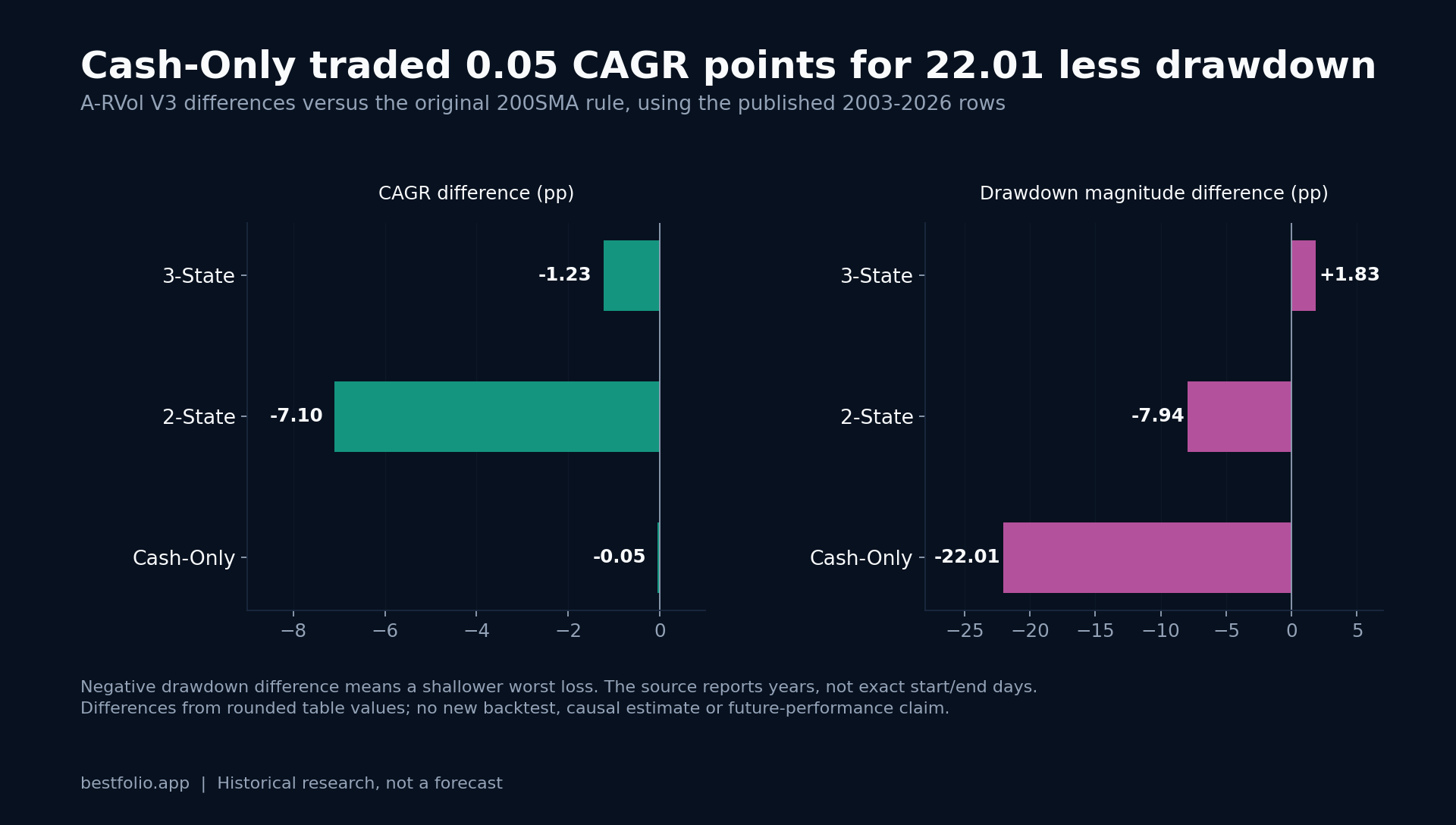
A few things to read in the numbers. The very deep drawdowns (RPEA Full and Simplified above 76%, Buy the Dip above 76%) are the dot-com and 2008 windows, where holding 3x leverage through a 50%-plus index drawdown produces multiplicative losses; even with the per-asset SMA timing in RPEA, the signal lag plus correlated drawdowns across sleeves is brutal. The Conservative and Adaptive Defense variants of RPEA exist precisely to bound that drawdown for users who cannot stomach 70%-plus, at the cost of meaningful CAGR. The A-RVol Shifter family illustrates a different tradeoff: V3 Cash-Only has the highest Calmar (0.65) because its drawdown is contained while CAGR stays at 25%, whereas Wongkok 200SMA (the unfiltered original) gets the highest CAGR but a 60% drawdown; the V3 filters earn their keep by clipping the worst of the moves. White Knuckle's backtest period is unusually short (2019-2026) because the MATE-style hedge sleeve funds did not exist before, so the numbers do not reflect a true cycle; the Sharpe of 0.60 is the lowest in the release for a reason. The unleveraged Cash Trigger sits at the other end of the spectrum (-26% Max DD, 0.87 Sharpe) and is the benchmark to beat for anyone running the leveraged strategies as standalones.
Where this leaves the catalog
Six of the seven strategies are leveraged. The seventh (Cash Trigger) is the unleveraged Carter companion that pairs with White Knuckle as the conservative cousin in the Carter ladder. Two of the leveraged strategies, TQQQ/UPRO Trend SMA and Buy the Dip, are r/LETFs-classic ideas that BestFolio has stabilized into shipping form (the core concepts of 200-day SMA gating on TQQQ and RSI/SMA dip-buying both predate us by years). The remaining four are implementations of strategies published by named authors on r/LETFs (RNAProf, u/Wongkok, u/Low-Initiative-1327) and by David Alan Carter.
Two thoughts on how to actually use any of these. Sleeve sizing matters more than strategy selection. A 5 to 10% allocation to White Knuckle inside a 90% indexed portfolio is a different animal from running White Knuckle as 50% of your wealth, even if the backtest is identical. And second: every leveraged strategy here has at least one period in the backtest where a buy-and-hold investor would have done better. Think of these strategies as risk-shifters first. They pull more equity exposure into trend-filtered regimes and pull it out (or invert it) when the filters trip. Return amplification is a side effect of getting the regime call right; it is not the goal of the strategy. If your goal is purely "I want more upside," you can add leverage to your existing index allocation directly. The strategies in this release exist for users who want a rules-based way to be aggressive while still having a defined exit.
All seven are live in the catalog now. They sit under the Tactical filter. Pro subscribers can backtest each one across the full data window we publish, and the monthly signal page shows the current allocation. Free users see the strategy pages and the rules; backtests and live signals are behind the Pro paywall as usual.
Attribution. TQQQ/UPRO Trend SMA and Buy the Dip are r/LETFs-classic ideas that BestFolio has stabilized into shipping strategies. We did not invent either core concept (200-day SMA gating on TQQQ, RSI/SMA dip-buying); both have made the rounds on r/LETFs and r/investing for years. What we added is the implementation: explicit hysteresis bands, a defined defensive regime, the QQQ-vs-SPY relative-strength filter (TQQQ Trend), the managed-futures pairing in the equity regime (TQQQ Trend), the SQQQ overheating leg (Buy the Dip), and the daily-eval mechanics. The five third-party strategies (RPEA, Low Initiative LETF V2, A-RVol Shifter, White Knuckle, Cash Trigger) are implementations of the originals as published by their respective authors. Where we deviate from the published spec (for example, real 2x gold instead of synthetic 3x in Low Initiative LETF V2), we say so on the strategy page. No claim of original authorship on either group.