Every great strategy has a tradeoff. The aggressive ones (HAA Leveraged, leveraged trend, accelerated dual momentum with capital-efficient ballast) get you 17 to 23% CAGR but spend a year or more under water at their worst. The defensive static portfolios (Cockroach, Permanent, Quartet) cap drawdowns at 20 to 30% but their CAGR caps too. Pick one and you live with whichever pain you signed up for.
The interesting question is what happens if you stop picking. Hold five strategies with genuinely different mechanisms and let the diversification do the work.
Here is the answer over a 33 year backtest using only strategies already in our catalog: 15.19% CAGR, -19.2% maximum drawdown, Sharpe 1.07. The Sharpe is higher than any of the five components held alone. The drawdown is lower than the best of them. That is not a coincidence, that is the point.
(A note on language up front: most of this 33 year window is technically in-sample for at least some of the components. HAA, BAA, and Cockroach were all published in roughly 2018 to 2020, so calling the full window "out of sample" would be sloppy. We will use "backtest" throughout. The forward-looking caveats are in their own section below.)
What "core-satellite" actually means
Core-satellite is a portfolio architecture, not a marketing label. It splits your capital into two roles:
- Core = the part of the portfolio that does not need to be right about regime, trend, or momentum. It is built to deliver acceptable returns through any market environment by holding genuinely different asset classes (or capital-efficient overlays of them) and rebalancing back to fixed weights. Static. Boring on purpose. The drawdowns are bounded by the diversification, not by any signal that might fail.
- Satellites = the parts that try to add return when conditions are right, and step out of the way when they are not. Tactical. Each satellite carries its own signal logic, its own definition of "the trend just changed", its own way of going defensive. They earn higher CAGR than the core, but they also spend more time wrong.
The reason to combine them rather than pick one is that they fail differently. The core does not have a bad year because of a missed signal, it has a bad year because every asset class went down. The satellites have bad years when their signal whipsaws. Those failure modes do not overlap, so when you put them in the same portfolio, the bad weeks of one are usually offset by the calm weeks of the others.
The traditional core-satellite split (in financial advisor land) is roughly 70-80% core / 20-30% satellites. We will use 60% core / 40% satellites because the satellites here are themselves diversified TAA strategies, not single-stock concentrated bets. They earn their larger weight by being conservative tactical rather than aggressive single-name.
The five strategies
Two static cores plus three tactical satellites, weighted 60/40 with even splits inside each tier:
| Tier | Strategy | Mechanism | Weight |
|---|---|---|---|
| Core (static) | Cockroach (5x20%) | 20% each of stocks, long bonds, gold, cash, managed futures. Annual rebalance. No signal. | 30% |
| Core (static) | Return Stacked Quartet (20/20/30/30) | 20% NTSX + 20% GDE + 30% RSST + 30% ZROZ. Capital-efficient overlays on one chassis. No signal. | 30% |
| Satellite (tactical) | HAA Leveraged 2x | Keller's hybrid asset allocation with TIP canary, applied at 2x leverage. | 13.33% |
| Satellite (tactical) | TQQQ Trend Proxy | Leveraged Nasdaq exposure with 200-day moving average trend filter. | 13.33% |
| Satellite (tactical) | ADM SmartStack (Gold+MF) | EngineeredPortfolio's accelerating dual momentum (1/3/6-month average) on US vs international small-cap, layered onto a gold + managed futures capital-efficient ballast. | 13.34% |
The deliberate design choice: the two cores share zero rules with the three satellites, and the three satellites each respond to a different signal. HAA reads the bond-stock correlation regime through its TIP canary. TQQQ Trend reads the equity trend channel. ADM reads accelerated relative momentum across stocks and bonds, with the leveraged ballast leg providing capital efficiency. So when one satellite gets a regime call wrong, it is rare for the other two to be wrong on the same axis at the same time.
A note on ADM's lineage: the dual-momentum framework comes from Gary Antonacci's 2014 book and his GEM strategy. ADM (Accelerating Dual Momentum) is a separate variant developed by EngineeredPortfolio (the blog from Chris Ludlow), which averages the 1, 3, and 6 month relative momentum and applies it to US small-cap vs international small-cap. The "SmartStack (Gold+MF)" wrapper is our overlay that replaces the cash safety asset with a capital-efficient gold + managed futures ballast. So ADM SmartStack inherits Antonacci's dual-momentum chassis, EngineeredPortfolio's acceleration on the signal, and our ballast on the defensive leg. Three layers, three different authors, all credited.
Why core/satellite specifically (and not just five-strategy equal weight)
You could argue that 20/20/20/20/20 across all five strategies would also blend their risks. It would, but you would lose two structural properties that matter:
- The cores anchor the portfolio when all three satellites are wrong at once. 2008 had this character. Trend filters were late. Dual momentum signals oscillated. The static cores held bonds and gold the whole way through. Equal-weighting would have given the satellites 60% of the portfolio, three times their share of the diversification benefit. The 60/40 split keeps the anchor heavy enough to absorb the rare regime where every signal fails together.
- The satellites earn their weight by being uncorrelated with each other, not just with the cores. If we let a single satellite drift to 30% it would dominate the satellite tier and we would be back to "pick the best one and hope". Cap satellites at roughly equal weight inside their tier, and you get the satellite-of-satellites diversification too.
The 60/40 split is also where the math sweet spot lives. We tested splits from 70/30 down to 40/60 and the Sharpe stays in a tight 1.06 to 1.08 band. Lower core means more CAGR and more drawdown. Higher core means less CAGR and slightly less drawdown. 60/40 sits at the highest Calmar (0.79) with the cleanest balance.
What the blend actually did, 1992-11-30 through 2026-05-01
The window starts at the latest common inception date across all five sleeves (HAA and ADM start in November 1992) and ends at the most recent backtest run on prod. That is 33.4 years and roughly 8,400 trading days, with monthly rebalancing back to the target weights.
| Metric | Cockroach | Quartet | HAA Lev 2x | TQQQ Trend | ADM Stack | BLEND |
|---|---|---|---|---|---|---|
| CAGR | 9.98% | 13.47% | 23.27% | 18.22% | 16.94% | 15.19% |
| Max drawdown | -20.9% | -30.4% | -34.2% | -28.8% | -23.9% | -19.2% |
| Volatility | 9.4% | 11.9% | 22.7% | 18.3% | 16.5% | 11.3% |
| Sharpe (rf=3%) | 0.74 | 0.85 | 0.89 | 0.81 | 0.85 | 1.07 |
| Sortino | 1.09 | 1.25 | 1.27 | 1.18 | 1.21 | 1.55 |
| Calmar | 0.48 | 0.44 | 0.68 | 0.63 | 0.71 | 0.79 |
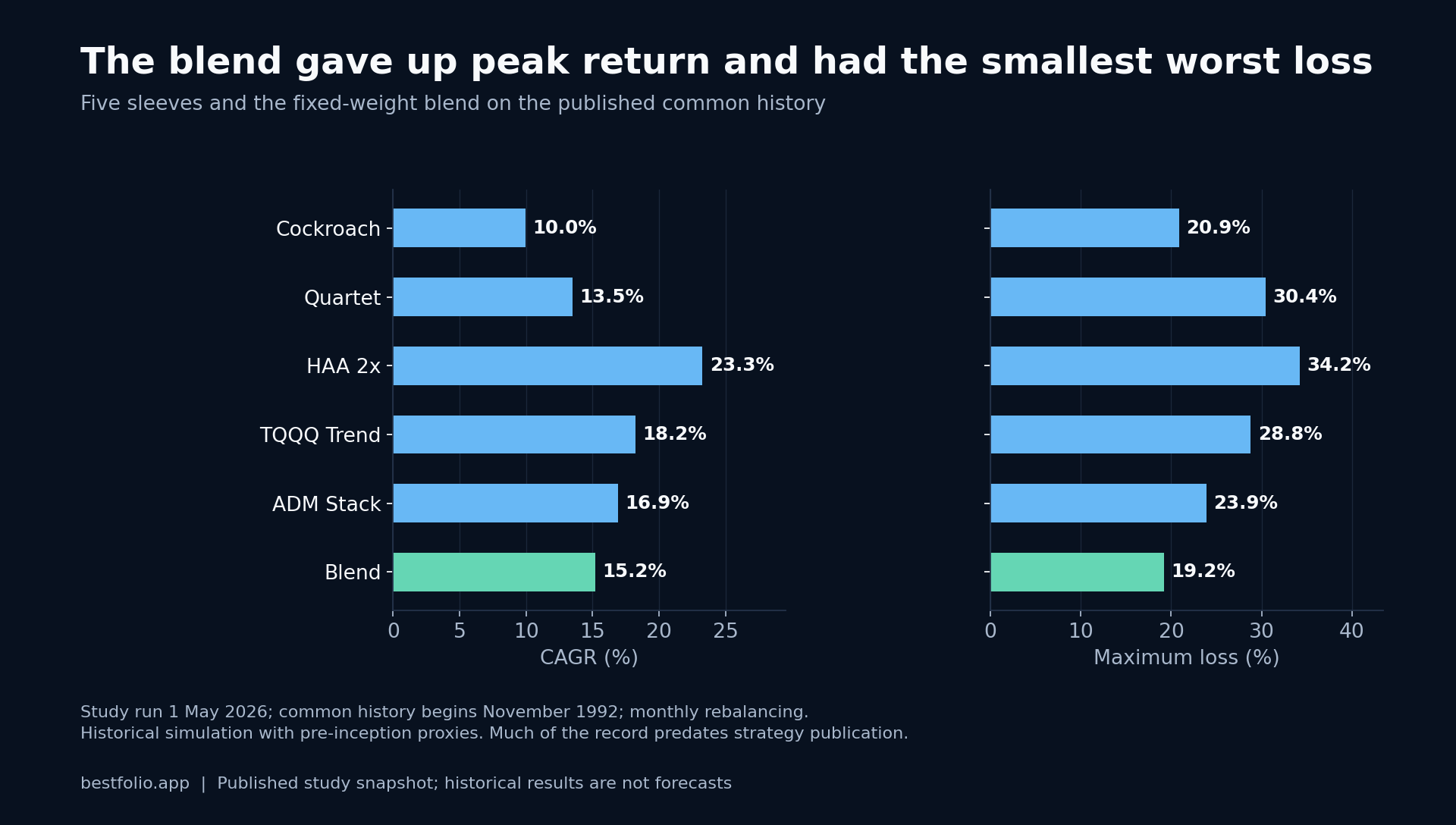
Read the bold column carefully. The blend's Sharpe of 1.07 is not within the range of the components, it is above all of them. Same story for Sortino at 1.55 and Calmar at 0.79. And the maximum drawdown of -19.2% is shallower than the best individual sleeve (Cockroach at -20.9%), even though three of the five components have drawdowns deeper than -28%.
This is what diversification across genuinely different mechanisms gets you: you sacrifice some peak CAGR (the blend's 15.2% sits below HAA Leveraged's 23.3% and below TQQQ Trend's 18.2%) but you keep the bulk of the average and you cut the painful drawdowns roughly in half compared to the most aggressive component.
How it held up across regimes
| Regime | Window | Blend CAGR | Blend MaxDD |
|---|---|---|---|
| Dot-com bust + recovery | 2000-01 to 2003-12 | 14.1% | -10.3% |
| 2008-09 GFC | 2007-10 to 2009-06 | -0.1% | -18.0% |
| Long QE bull | 2009-07 to 2019-12 | 14.0% | -12.2% |
| COVID crash + recovery | 2020-02 to 2020-12 | 31.8% | -19.2% |
| 2022 inflation + rates | 2022-01 to 2022-12 | -10.9% | -14.6% |
| 2023-25 recovery | 2023-01 to 2025-12 | 16.4% | -14.1% |
A few honest observations:
- The 2000 to 2003 dot-com bust was the blend's strongest regime relative to the S&P, which lost roughly 35% peak to trough. The blend gained 14% annualized and the worst it ever felt was -10.3%. That is mostly the trend filters in HAA, TQQQ Trend, and ADM doing their job, while the static cores held gold and long bonds.
- The 2008 GFC was the hardest regime. Blend was roughly flat across the 21 month window with an -18% drawdown along the way. Bonds and gold inside Cockroach, plus the Quartet's bond-stack legs, did most of the heavy lifting on the way down. The satellites caught the recovery on the way back.
- 2022 was the second-hardest regime. Stocks and long bonds fell together, gold was flat, and the only sleeve that actually made money was the managed futures inside Cockroach and ADM Stack. Blend lost 10.9% on the calendar year, half of what the S&P 500 lost that year.
- COVID is interesting. The blend's all-time max drawdown of -19.2% happened in March 2020, in the most violent four-week sell-off in modern history. By December 2020 the blend was up roughly 32% on the year. The drawdown was real, the recovery was fast.
Calendar year statistics
- Positive calendar years: 30 out of 35 (86%).
- Worst calendar year: 2022 at -10.9%.
- Best calendar year: 2003 at +38.1%.
- Worst rolling 12 months: -16.2% ending October 2008.
That is a portfolio profile that very few investors associate with "five tactical and leveraged strategies inside it". The aggressive components are aggressive, and yet the blend behaves like a moderately aggressive but well-mannered portfolio.
Two real critiques worth addressing up front
This is a public methodology piece and the smarter readers in the TAA community will spot two design tensions immediately. Better to say them ourselves.
The cash-and-leverage tension inside the blend
Cockroach holds 20% cash inside its 30% allocation, so 6% of the total portfolio is sitting in T-bills. The Quartet runs roughly 1.4x effective leverage through NTSX, GDE, and RSST, which means that side of the portfolio is paying T-bill plus a small financing spread (around 30 to 40 basis points on the leveraged notional) to get the synthetic exposure. So we earn T-bill on 6% of the dollars and pay T-bill plus a spread on roughly 18% of leveraged notional. Net friction: 10 to 15 basis points of annual drag.
You can fix this two ways. The principled fix is to reweight the Cockroach sleeve and replace the 20% cash leg with another defensive asset (more long bonds, or splitting between TIP and cash). The other answer, the one we used in the headline numbers, is to keep Cockroach exactly as Keith Smith designed it. Cockroach is a complete static strategy with five intentionally diverse legs, and modifying one leg to reduce drag against an unrelated sleeve breaks the design intent. The 10 to 15 bps cost is real and you should know about it; we don't think it justifies butchering an external strategy. Both answers are defensible, pick the one whose tradeoff you prefer.
The backtest window matters more than the headline implies
Our window starts in November 1992 because that's the latest common inception of the five components (HAA and ADM both start there). 33 years sounds like a lot, and it is, but the period from 1992 onward inherits two regime tailwinds that are not normal across all market history.
Long bonds have been in a structural bull market for most of this window. The 30 year Treasury yielded around 7% in late 1992 and bottomed near 1% in 2020. That single regime did most of the heavy lifting for the Quartet's ZROZ leg and for Cockroach's long-bond sleeve. If we had access to data starting in 1972, the Quartet's bond legs and HAA's defensive baskets would have lost meaningful ground through the 1973 to 1981 inflation cycle. Gold tells a similar story in reverse: post-1980 was a multi-decade bear that our window misses entirely.
What this means in practice: take roughly 1.5 to 2 percentage points off the published CAGR before forecasting forward, and assume the maximum drawdown could be a few hundred basis points worse than -19% in a long-rate-rising regime. The Sharpe is more stable across regimes than the CAGR but it is also lower than 1.07 in unfavorable bond and gold environments. The headline numbers are a best-of-recent-history reference. The expected forward path is probably lower.
Why this works (the un-mysterious version)
There is no magic in the math. When you blend five return streams whose pairwise correlations average somewhere around 0.4 to 0.6, the volatility of the blend falls faster than the average of the volatilities. Sharpe is return-over-volatility, so dropping volatility while keeping a healthy portion of the return raises Sharpe. The same diversification effect compresses drawdowns: when one sleeve is in its worst drawdown, the others are usually not, so the portfolio-level drawdown is shallower than any individual member's.
What does require some thought is which strategies you put in. Five strategies that all read the same signal (say, five momentum strategies on different lookbacks) will not give you this result, because their drawdowns happen at the same time. The blend above works because the five mechanisms are genuinely independent:
- Cockroach uses no signal at all. Five static asset classes.
- Quartet uses no signal at all. Four static capital-efficient ETFs.
- HAA Leveraged reads a binary canary (TIP relative momentum) to flip between offensive and defensive baskets.
- TQQQ Trend reads the 200-day moving average on QQQ to flip between leveraged Nasdaq and cash.
- ADM SmartStack reads accelerated dual momentum (1/3/6-month average) across US and international small-cap, with the capital-efficient stack as ballast.
So the satellites can disagree with each other (and with the cores) without all rotating into the same trade.
A simpler implementation: RSST as a single-ETF core
If maintaining a 4-ETF Quartet feels like too many moving parts, there is a cleaner version where the second core collapses into a single ETF: RSST itself. RSST is Return Stacked U.S. Stocks & Managed Futures, a wrapper that gives you 100% S&P 500 exposure and 100% managed futures overlay on the same dollar. Two return drivers in one ticker.
Replace the Quartet's 4-ETF static with 15% RSST + 15% ZROZ as your second core. Now the portfolio is:
| Tier | Holding | Weight |
|---|---|---|
| Core (static) | Cockroach (5x20%) | 30% |
| Core (static, simplified) | RSST (stocks + MF) | 15% |
| Core (static, simplified) | ZROZ (long-duration Treasuries) | 15% |
| Satellite | HAA Leveraged 2x | 13.33% |
| Satellite | TQQQ Trend Proxy | 13.33% |
| Satellite | ADM SmartStack | 13.34% |
You drop the GDE gold leg and the NTSX bond+stocks leg from the second core. Cockroach already provides gold (20% of its 30% slice = 6% portfolio), so that leg is partially preserved. You lose a bit of capital efficiency on the equity side but the simplicity gain is real. On the same 33-year window, this variant produces:
- CAGR 14.86% (vs 15.19% original, a 33 bps cost)
- Max drawdown -17.9% (vs -19.2% original, slightly shallower because the synthetic Quartet pre-2018 carries a touch more equity drag than direct ZROZ)
- Calmar 0.83 (vs 0.79 original)
The risk-adjusted profile is essentially the same. The cost of simplification is a third of a percent in CAGR. The benefit is one fewer rebalance to think about per year and three fewer ETF tickers in your account. Reasonable trade for a smaller portfolio or anyone who values low operational overhead.
You can push the simplification one step further and drop Cockroach too, going to a pure 2-core RSST + ZROZ design. That variant tested at CAGR 15.47% / MaxDD -19.3% / Calmar 0.80 with 30/30/13.3/13.3/13.3 weights, but the Sortino drops noticeably because you lose the gold leg from Cockroach. We would not recommend going this minimal unless the satellite tier already captures gold exposure (the SmartStack ETF inside ADM has a small gold component). The Cockroach + RSST + ZROZ + 3 satellites version is the better simplified target.
What we are not telling you
A blog post that only shows the headline numbers is not honest. The caveats:
- Synthetic pre-inception data is in two of the five sleeves. The Quartet uses a synthetic NAV chain for RSST before its 2024 inception (built from the underlying components). TQQQ Trend uses a Nasdaq leverage proxy before TQQQ's 2010 launch (computed from the daily 3x reset on the underlying index, with realistic financing assumptions). HAA Leveraged 2x is treated conceptually with daily leverage applied to the unleveraged HAA NAV, not as an investable wrapper that exists today. We disclose all of this on the strategy detail pages and in the backtest engine logs.
- The simpler variant uses synthetic RSST and ZROZ. RSST's real ETF only goes back to September 2023. ZROZ's real ETF goes back to 2009. Pre-inception we use BestFolio's price-builder fallback chains (S&P 500 plus a managed-futures index for RSST, long-duration Treasury yield curve construction for ZROZ). The chains are documented in
fallback_table.pyand visible in the price build log on every backtest. - Implementation friction is real. Five strategies of varying mechanics means somewhere between 12 and 20 ETFs in actual execution at any given month. For accounts under $50K, the rebalancing tax and the cost of fractional shares chip noticeably into the published returns. The numbers above are gross of trading costs and assume no slippage.
- Past performance, etc. A 33 year backtest is a lot of ground but it is still one path. The forward path will look different.
- Tax inefficiency. The satellites turn over monthly. In a taxable account, that pulls realized short-term gains forward. The blend works best in a tax-deferred wrapper (IRA, 401k, ISA, PEA, depending on jurisdiction).
- You still have to follow the satellites every month. Cockroach and Quartet rebalance annually and require almost no attention. The three satellites need a monthly trade. Skipping one because life happened that week is the most common failure mode of any tactical portfolio, and it does not get easier when you have three of them.
How to test this in BestFolio
Every component above is in the strategy catalog at bestfolio.app/strategies. The static cores are free to inspect. The two SmartStack and Leveraged variants are Pro. To replicate either blend yourself:
- Open /portfolios in BestFolio.
- Create a new portfolio and add the strategies above with the listed weights.
- Hit "Run backtest" to see the same chart we ran for this post.
- Use the live signals page to track the satellites monthly. The cores rebalance once a year.
The numbers in this post will reproduce, modulo a few basis points of difference if you tweak the start date or use slightly different rebalancing dates.
Bottom line
The honest reason to combine five strategies instead of picking one is not that any one of them is broken. HAA Leveraged at 23% CAGR is not broken. The reason is that the maximum drawdown of any single aggressive strategy is roughly 30 to 35%, and most investors will not hold through that. A 19% maximum drawdown is something a normal person can sit through. That alone justifies trading away some of the peak CAGR.
The bonus is that the Sharpe ratio actually goes up. The math says you should not get both, lower drawdown and higher risk-adjusted return. The fact that you do get both, when the components are genuinely uncorrelated, is one of the few free lunches finance hands you. Core-satellite is the architecture that makes the free lunch eatable: anchor with strategies that cannot be wrong about regime, accelerate with strategies that can. The math takes care of the rest.
All numbers in this post come from BestFolio's backtest engine on production data, run on 2026-05-01. Strategy metrics are pulled directly from the prod database. The blend computation script is reproducible and uses monthly rebalancing back to the target weights. If you want the raw NAV series for the blend, ask in the comments.