·8 min read·BestFolio Research Team

Best Brokers for European TAA Investors (2026)

If you are running tactical asset allocation from Europe, your broker choice matters more than it does for buy-and-hold investors. TAA strategies rebalance monthly (sometimes more often), which means commissions, FX fees, and spread costs compound across dozens of trades per year. The wrong broker can easily eat 0.5–1% of annual returns in friction alone.

We tested six popular European brokers against the specific needs of a TAA investor: commission per trade, FX conversion costs, UCITS ETF coverage, fractional share support, and tax reporting. Here is what we found.

What TAA Investors Actually Need From a Broker

Before jumping into the comparison, it helps to understand why TAA has different broker requirements than buy-and-hold:

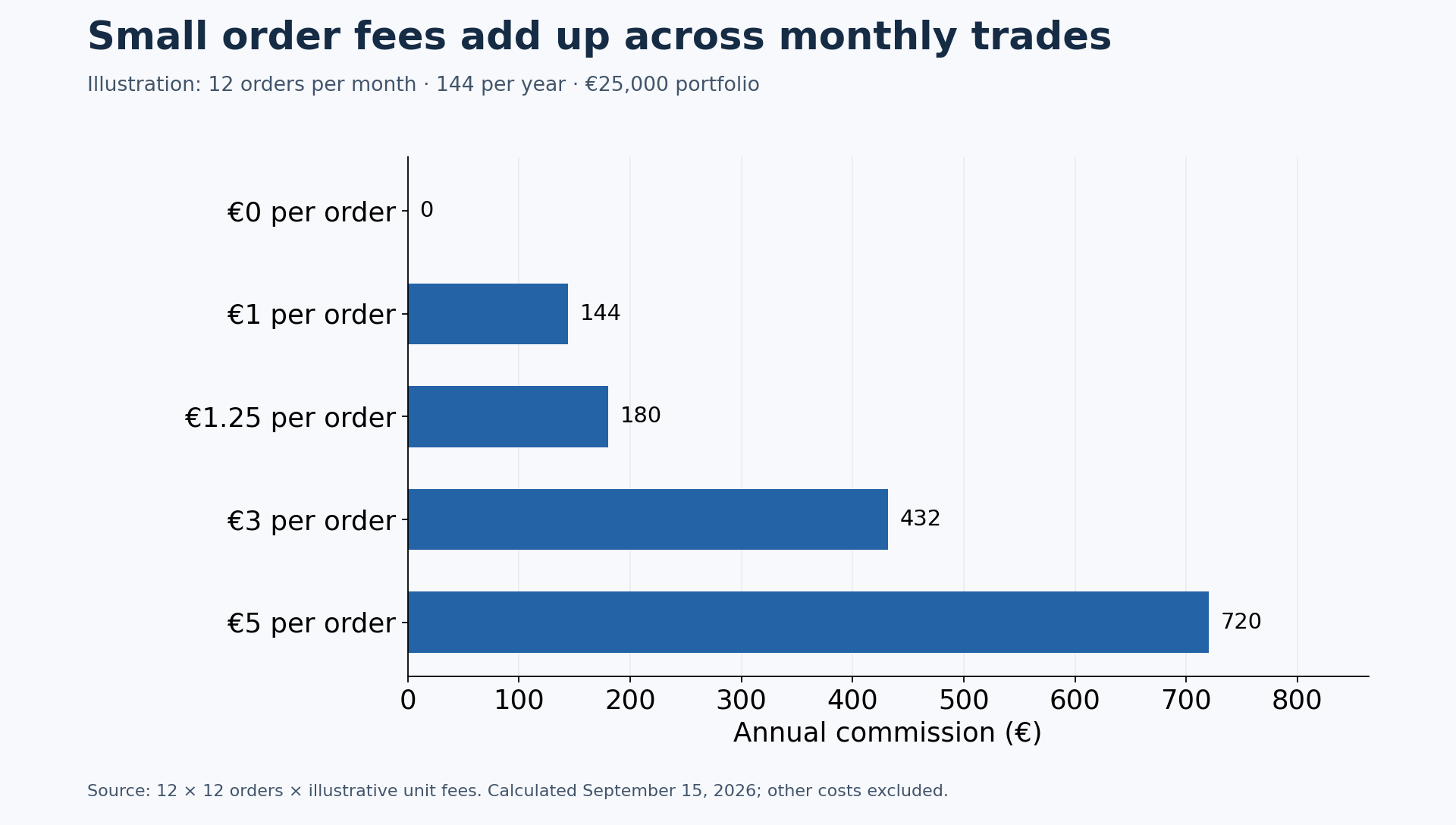
  • Trade frequency: A typical TAA strategy executes 3–8 trades per month. A blend of 4 strategies could mean 15–25 trades monthly. At €1 per trade, that is €180–300/year in commissions alone.
  • Multi-asset coverage: TAA rotates across equities, bonds, gold, and sometimes REITs or commodities. You need a broker that offers UCITS versions of all these asset classes.
  • FX costs: Most UCITS ETFs trade in EUR, but some (especially bond and commodity ETFs) trade in USD or GBP on exchanges like LSE. Currency conversion fees add up fast when you are rebalancing monthly.
  • Fractional shares: When a strategy says “allocate 12.5% to gold,” you need to buy exactly that amount. Without fractional shares, small portfolios end up with significant rounding errors that drag on performance.
  • Speed of execution: TAA signals are typically generated on the last trading day of the month. You want a broker where you can execute all trades in one session, not one where order types are limited or certain ETFs require phone orders.

The Comparison

Feature IBKR DEGIRO XTB Trading 212 Saxo Lightyear
ETF commission €1.25 (tiered) €1–3 + €2.50 exchange Free (under €100K/mo) Free €3–8 Free
FX conversion fee 0.002% (min $2) 0.25% 0.50% 0.15% 0.25–0.75% 0.35%
UCITS ETF coverage Excellent Good Moderate Moderate Good Limited
Fractional shares Yes (most ETFs) No Yes Yes No Yes
Tax reporting (EU) Annual statement Annual statement PIT auto (PL, CZ) Annual statement Annual statement Annual statement
Account minimum None None None None (GBP £1) €2,000 None
Exchanges available 150+ 30+ 16 8 40+ 6
API access Yes (TWS/REST) No Partial No Yes (OpenAPI) No

Our Verdict by Broker

Interactive Brokers (IBKR) — Best Overall for TAA

IBKR wins for TAA investors and it is not close. The FX conversion at 0.002% is essentially free compared to every competitor. Commission per ETF trade is around €1.25 on the tiered plan. The UCITS coverage is the widest available — we have yet to find a UCITS ETF listed on a European exchange that IBKR does not offer. Fractional shares work on most ETFs, which solves the rounding problem for smaller portfolios.

The downsides: the interface is intimidating (Trader Workstation looks like it was designed in 2003), customer support can be slow, and the tax statements require some manual work depending on your country. KYC renewals have also frustrated some users. But for pure execution cost, nothing comes close.

Cost example: A €25K portfolio running 4 blended strategies with ~20 trades/month: ~€300/year in commissions + essentially €0 in FX. Total friction: 1.2%.

DEGIRO — Good Coverage, No Fractional Shares

DEGIRO has decent UCITS coverage and reasonable commissions, but the lack of fractional shares is a dealbreaker for TAA on smaller portfolios. If a strategy tells you to hold 15% in a €200 bond ETF and your portfolio is €10K, you can only buy 7 shares (€1,400) instead of the target €1,500. That 1% rounding error per position adds up across 6–8 holdings.

The 0.25% FX fee also stings on monthly rebalancing. If you trade USD-denominated ETFs on LSE, that is 3% annually just in currency conversion on a position you rotate every month. Stick to EUR-denominated ETFs on Xetra or Euronext to minimize this.

Best for: European TAA investors with portfolios above €50K who do not need fractional shares.

XTB — Free Trades, Weak Coverage

Zero commission under €100K monthly volume sounds great, and it is — for buy-and-hold. But XTB’s UCITS ETF selection is more limited than IBKR or DEGIRO. Some of the bond and commodity ETFs that TAA strategies rely on (intermediate treasuries, commodity baskets, TIPS) are either missing or only available on exchanges with poor liquidity.

The 0.50% FX fee is the highest in this comparison. If any of your target ETFs trade in a non-EUR currency, that cost erases the commission savings quickly.

The big advantage: automatic PIT tax document generation in Poland and Czech Republic. If you are in one of these countries and tax reporting is your biggest pain point, XTB is worth considering despite the other limitations.

Best for: Polish/Czech investors who prioritize tax simplicity over execution cost.

Trading 212 — Great for DCA, Limited for TAA

Zero commissions and fractional shares make Trading 212 excellent for buy-and-hold DCA strategies. The 0.15% FX fee is competitive. But the ETF selection is limited to about 8 exchanges, and some niche UCITS ETFs (managed futures, alternative risk premia) are simply not available.

The platform is also geared toward simplicity, which means fewer order types and no API access. For a TAA investor executing 15–20 trades on the last day of the month, the manual process can be tedious.

Best for: Beginners running a single simple TAA strategy (like GEM or Faber’s GTAA) with a limited number of positions.

Saxo — Premium Price, Premium Service

Saxo has good UCITS coverage and a polished interface, but the commissions are the highest in this comparison. At €3–8 per trade, a TAA investor executing 20 trades/month is paying €720–1,920/year in commissions alone. On a €25K portfolio that is 3–8% annually — completely unacceptable.

Saxo makes more sense for large portfolios (€100K+) where the commission drag becomes a smaller percentage. The API access via OpenAPI is a plus for automated execution.

Best for: Large portfolios (€100K+) that want API-driven automated rebalancing.

Lightyear — Too Early for TAA

Lightyear is a newer entrant with free trades and fractional shares, but the ETF coverage is still very limited (6 exchanges). Many UCITS bond and commodity ETFs are missing entirely. The platform is also newer and less battle-tested on regulatory and operational stability.

Best for: Simple equity-only strategies. Not recommended for multi-asset TAA yet.

The Real Cost: A Worked Example

Let’s put real numbers on this. Assume you are running a blend of 3 TAA strategies that together hold 8 positions, rebalanced monthly. Half the positions trade in EUR, half in USD. Your portfolio is €25,000.

Monthly trades: ~12 (not all positions change every month). Annual trades: ~144.

Broker Commissions/yr FX costs/yr Total friction % of portfolio
IBKR €180 €3 €183 0.73%
Trading 212 €0 €188 €188 0.75%
XTB €0 €625 €625 2.50%
DEGIRO €504 €313 €817 3.27%
Saxo €792 €313 €1,105 4.42%

The difference between the cheapest and most expensive option is 3.7% annually. Over 10 years on a €25K portfolio growing at 10%, that is roughly €12,000 in lost returns from broker friction alone.

Tips for Minimizing Friction

  1. Stay in EUR. Wherever possible, choose EUR-denominated UCITS ETFs on Xetra or Euronext. Most popular ETFs (MSCI World, S&P 500, Aggregate Bond) have EUR-traded versions. This eliminates FX costs entirely.
  2. Batch your trades. Execute all rebalancing trades in one session on the last trading day of the month. Avoid dripping trades across multiple days, which increases spread costs and complicates record-keeping.
  3. Use limit orders. Market orders on less liquid UCITS ETFs can cost 0.1–0.3% in spread. Limit orders at the midpoint save money and are worth the extra 30 seconds per trade.
  4. Consider the rollup threshold. If a strategy allocates 3% to a position, that is only €750 on a €25K portfolio. The commission and spread on such a small trade may not be worth it. BestFolio’s rollup feature lets you set a minimum position threshold — allocations below it get redistributed to larger positions, reducing the number of trades without meaningfully changing the risk profile.

Which Broker Should You Pick?

For most European TAA investors, the answer is IBKR. The combination of near-zero FX costs, €1.25 commissions, the widest UCITS selection, and fractional shares makes it the clear winner for anyone rebalancing more than once a quarter.

If you are in Poland or Czech Republic and tax reporting is a major concern, XTB is a reasonable second choice — but only if you can stick to EUR-denominated ETFs to avoid the 0.50% FX fee.

Trading 212 is a solid option for beginners running a single simple strategy with few positions, especially if all your target ETFs are available on their platform.

Once you have your broker sorted, the next step is getting reliable monthly signals. BestFolio tracks 40+ TAA strategies with UCITS ETF mappings so you know exactly which European ETFs to buy. You can start with the free strategies to see how the workflow feels before committing to a paid plan.

Disclaimer: Broker fees and features change frequently. The figures in this article were accurate as of March 2026 but may have changed since publication. We have no affiliate relationship with any broker mentioned. We are not financial advisors and this is not investment advice.

Share this article

Try these strategies on BestFolio

Browse 63+ tactical allocation strategies with monthly signals, walk-forward validation, and portfolio blending. Free to start.

Get Started Free