AWEA, which its author expands as All Weather Experimental Adventure, is the second strategy from u/Separate-Ad-9633 in this batch and his third in the catalog. It arrived as part of a public critique of one of our own listings, which is the most useful kind of contribution we get. Here is what the card shows now that it is live.
What the rule does
AWEA is a leveraged all-weather book with 6 sleeves. The departure from the usual pattern is that each sleeve carries its own trend gate rather than the whole portfolio sharing one. A sleeve is either on, holding its leveraged asset, or off.
What happens to a sleeve that switches off is the second departure. Instead of routing the weight into one fixed defensive asset, it walks down a ladder: long Treasuries first, then gold, then intermediate Treasuries, then cash. The point of the ladder is that the defence is not betting everything on a single asset behaving well in the specific crisis you are in.
That is a direct answer to the criticism the author levelled at our RPEA listing, where the defensive leg is TMF alone. If long Treasuries are the thing that is breaking, a TMF-only defence has nowhere to go. The ladder does.
What the card says
| Metric | AWEA Standard | AWEA with Europe | 100% US Stock Market |
|---|---|---|---|
| CAGR | 26.05% | 25.45% | 11.40% |
| Sharpe | 1.00 | 1.01 | 0.80 |
| Sortino | 1.77 | 1.78 | 1.24 |
| Max drawdown | -47.65% | -45.56% | -55.45% |
| Annualised volatility | 24.69% | 23.38% | 17.81% |
| Months to recover that drawdown | 25 | 25 | 53 |
| Annual turnover | 2.34x | 2.42x | 0.01x |
| History on the card | 54.5 years | 54.5 years | 38.7 years |
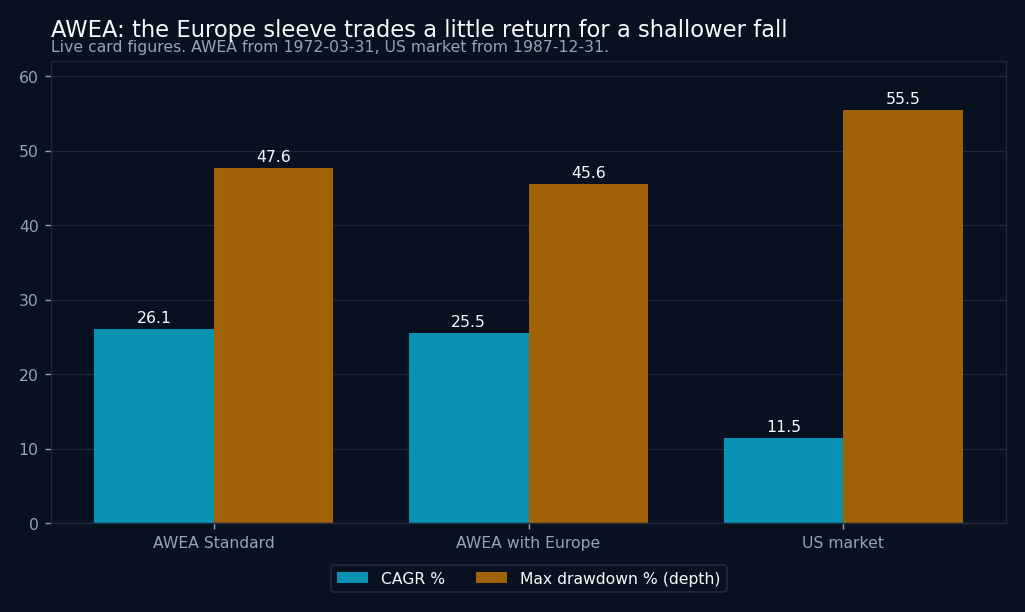
The number that matters is not the CAGR
AWEA Standard fell 47.65% at its worst, in the October 1987 crash, and took 25 months to get back. Less than 3 years later it was down 45.97% again, at the August 1990 low. That is 2 falls of close to half the book inside 3 years, on a book you are holding precisely because it is supposed to be all weather. The sleeve-level gates and the defensive ladder did not prevent either, and no honest reading of this card should suggest otherwise.
That is shallower than the unlevered US market's 55.45%, but the market row starts after the 1987 crash, so the 2 figures do not cover the same years. Sizing this as a core holding because the headline says all weather would be a mistake.
The Europe variant is the interesting row. It gives up 0.60 points of CAGR for a slightly shallower fall, 45.56% against 47.65%, with the same 25 months under water. On this card the diversification buys little: about 2.1 points of drawdown and a little less volatility for the return it costs.
Why the card starts in 1972
The card runs from March 1972, which is 54.5 years. That is deliberate. A window starting in the mid-1990s would put the 1987 crash behind the edge of what you can see, and for a leveraged trend book the 1987 episode is one of the few genuine tests in the record. On this card it is also the worst fall. Showing a shorter, flattering window would make the strategy look better and tell you less.
The usual caveat applies with force here: most of the leveraged funds in this universe did not exist in 1972. The early history is a reconstruction from the underlying indices, not a record of trades anyone could have made.
The useful conclusion
The ladder is a better answer to defensive concentration than a single fixed hedge. But the case for AWEA rests on the mechanism, not on the 26.05%, and the price of admission is a fall of close to half the book, twice between 1987 and 1990.